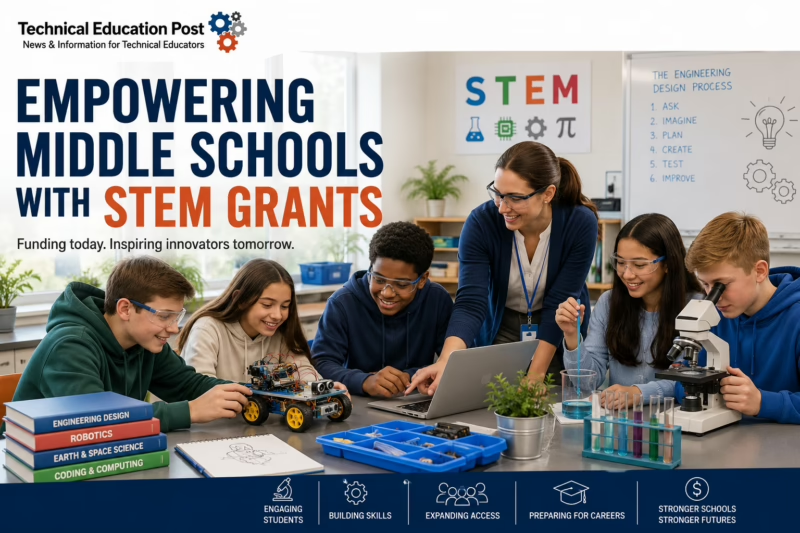
Empowering Middle Schools with STEM Grants
Middle schools do not need another grant-funded closet filled with unused robotics kits, outdated laptops, or equipment that no one was trained to operate.
They need STEM grants that create lasting learning opportunities.
The most effective grants help schools build complete programs in which students investigate authentic problems, apply mathematics and science, design prototypes, use technical tools, collaborate with mentors, and connect their classroom work to future education and careers. Equipment may be part of that plan, but it should support the learning model rather than define it.
That distinction is especially important in the middle grades. Students are beginning to form beliefs about which subjects interest them, whether they belong in technical environments, and what kinds of careers may be available to them. A well-designed grant can open those possibilities to an entire student population. A poorly designed grant may create a short-lived club or isolated purchase that disappears when the initial funding is exhausted.
For educators and administrators, the challenge is therefore larger than finding an open application. Schools must identify the right funding source, define a meaningful student need, construct a realistic budget, prepare teachers, measure results, and plan for sustainability from the beginning.
Executive Summary
Middle school STEM grants can support robotics, engineering design, computer science, scientific instrumentation, environmental research, makerspaces, teacher professional development, after-school programs, and career exploration. The strongest proposals, however, do not begin with a product list. They begin with a clearly documented educational problem.
That need is visible nationally. In 2024, only 28 percent of eighth-grade students performed at or above the NAEP Proficient level in mathematics. In science, 31 percent reached or exceeded NAEP Proficient, while the average eighth-grade science score was four points lower than in 2019. (NAEP mathematics results; NAEP science results)
Schools have several possible funding paths. Federal formula programs such as Title IV, Part A and Perkins V may support STEM access, technology, career exploration, and related professional learning. Competitive programs offered by foundations, corporations, professional associations, and the National Science Foundation can support classroom projects or larger research partnerships.
The central funding lesson is straightforward: use grants as strategic seed capital. Invest in teacher capacity, curriculum, access, consumable materials, maintenance, assessment, and partnerships—not merely equipment.
Key Takeaways
1. Begin with a student need, not a technology purchase. Funders want to understand the problem the project will solve.
2. Treat middle school STEM as a pathway-building strategy. Programs should connect to high school CTE, advanced coursework, industry sectors, and postsecondary options.
3. Combine funding sources when appropriate. Federal formula funds, competitive grants, local foundations, and industry support can serve different parts of the same initiative.
4. Budget for people as well as equipment. Training, planning time, curriculum development, technical support, replacement materials, and accessibility often determine whether a program lasts.
5. Measure participation and opportunity—not only test scores. Student access, persistence, skill development, project completion, career awareness, and representation are also meaningful outcomes.
Quick Facts
Why the Middle Grades Deserve Targeted STEM Investment
Middle school is often caught between two institutional priorities. Elementary schools focus heavily on foundational literacy and numeracy, while high schools receive much of the attention given to CTE pathways, dual enrollment, advanced coursework, credentials, and workforce preparation.
That can leave the middle grades without a coherent role.
Yet grades six through eight are precisely where schools can help students move from general curiosity to structured exploration. Students can begin using professional practices—investigating problems, collecting data, programming devices, working from technical drawings, testing prototypes, documenting failures, and revising designs—without being pushed prematurely into a narrow occupational track.
The National Academies has emphasized that authentic computing and STEM experiences should resemble real professional practice and connect with problems students consider meaningful. Sustained exposure across multiple experiences is more likely to build interest, belonging, and a durable STEM identity than a single event or isolated activity. Read the National Academies brief.
This has direct implications for grant planning. A one-day demonstration may generate excitement, but a semester-long design sequence can build competence. A robotics assembly may attract an audience, but a program in which every seventh grader learns sensors, programming, mechanical systems, teamwork, and technical communication can change who sees themselves as capable of technical work.
Middle school funding also strengthens the transition into high school. Perkins V recognizes the role of the middle grades in career exploration and career awareness. Federal guidance notes that middle-grade programming may include introductory courses and activities that help students understand careers before entering a formal CTE program of study. Review the federal CTE middle-grades resource.
The goal is not to ask a 12-year-old to select a permanent career. It is to make sure that students know technical careers exist—and that those careers are not reserved for someone else.
Where Middle Schools Can Find STEM Funding
There is no single national funding source designed to cover every middle school STEM initiative. Schools should instead think in terms of a funding portfolio.
Major Funding Pathways
| Funding source | Best use | Primary applicant | Important consideration |
|---|---|---|---|
| Title IV, Part A | STEM courses, hands-on projects, computer science, educational technology, professional learning, career guidance, and expanded access | School districts through state allocations | Funding decisions are generally made through district planning and must reflect program requirements and identified needs. |
| Perkins V | Middle-grade career exploration, introductory CTE experiences, pathway development, and alignment with workforce needs | States, districts, and eligible CTE recipients | The project must align with the state plan, local application, and comprehensive local needs assessment. |
| 21st Century Community Learning Centers | After-school, summer, and extended-learning STEM enrichment | State-administered subgrants, frequently involving districts and community partners | The program emphasizes out-of-school academic enrichment, particularly for students attending high-poverty and low-performing schools. |
| NSF STEM K-12 | Research-based curriculum development, emerging technology, AI education, learning research, evaluation, and scalable models | Eligible institutions, nonprofits, state and local governments, tribal nations, and other qualifying organizations | This is a research and development opportunity, not a conventional classroom equipment grant. Partnerships with universities or research organizations may strengthen a proposal. |
| Toshiba America Foundation | Teacher-led, project-based STEM learning in grades 6–12 | Individual teachers | Offers grants of up to $5,000 and grants exceeding $5,000, with separate application schedules. |
| Samsung Solve for Tomorrow | Community problem-solving projects using STEM, student design, prototypes, and applied innovation | Teacher-led student teams | Schools can compete for substantial classroom resources, but the program operates through an annual competition cycle. |
| Voya Unsung Heroes | Innovative K–12 classroom projects across subject areas, including STEM | Educators | Fifty finalists receive $2,000, with additional awards for the top three projects. |
| AIAA Classroom Grants | Aerospace, rocketry, robotics, flight, mathematics, and related engineering projects | K–12 classroom teachers | Grants are up to $500 and require an aerospace connection and AIAA Educator Associate membership. |
| Local foundations and employers | Equipment, mentors, site visits, transportation, showcases, competitions, and locally relevant career projects | Varies | The strongest requests connect the project to a community need without turning the classroom into a corporate advertisement. |
Federal formula funding is frequently more sustainable than a one-time competition, but it requires early coordination with district administrators. Teachers should speak with their principal, federal programs director, CTE director, curriculum leader, and grant office before assuming that no funding is available.
A district may already receive resources that can support the proposed work, even when those funds are not labeled as a “STEM grant.”
What a STEM Grant Should Actually Fund
1. A Defined Learning Experience
The proposal should explain what students will do.
“Purchase ten robotics kits” is a procurement request.
“Engage all seventh-grade students in a 12-week engineering sequence in which teams design, program, test, and document an autonomous device that addresses a school accessibility problem” is an educational project.
The equipment matters, but it is subordinate to the student experience.
2. Teacher Training and Planning Time
Even intuitive-looking technology can create implementation problems. Teachers need time to learn the equipment, align lessons with standards, develop assessments, prepare troubleshooting procedures, coordinate with special educators, and determine how the project will fit within the school schedule.
Professional development should not be treated as an optional add-on. It is part of the infrastructure of the program.
3. Consumable and Replacement Materials
Many grant budgets account for the initial purchase but overlook the second year.
Projects may require batteries, sensors, wire, adhesives, fasteners, fabrication materials, replacement components, safety supplies, printer filament, laboratory consumables, software renewals, or calibration.
A sustainable budget identifies which costs are recurring, how frequently materials must be replaced, and which funding source will cover them later.
4. Accessibility and Inclusive Participation
STEM access is not achieved by placing equipment in a building.
Schools should consider whether students with disabilities can manipulate materials, see displays, hear instructions, access software, navigate workspaces, or participate meaningfully in team roles. Multilingual learners may need visual vocabulary, translated family communication, additional modeling, or structured technical-language support.
The program should also avoid creating an informal gatekeeping system in which only students already viewed as “good at math” are invited to participate.
5. Measurement and Documentation
Schools should know what success will look like before the project begins.
- Number and percentage of students participating
- Participation by demographic group
- Completion of technical tasks or design challenges
- Growth in engineering, computing, or scientific-practice skills
- Student confidence and sense of belonging
- Interest in related high school courses
- Enrollment in subsequent STEM or CTE programs
- Teacher implementation confidence
- Number and quality of community partnerships
A funder is more likely to support a project when the school can explain how it will recognize improvement.
6. Connections Beyond the Classroom
Middle school STEM becomes more powerful when students can see where their skills lead.
Community colleges, universities, manufacturers, utilities, hospitals, engineering firms, construction companies, agricultural organizations, public agencies, and skilled-trades employers may contribute mentors, facility tours, technical feedback, project problems, speakers, equipment donations, or student showcases.
Those partners should deepen the educational experience. They should not determine the curriculum or convert the project into a sales presentation.
An Illustrative $25,000 STEM Grant Budget
The following budget is not a universal formula. It demonstrates how a school might distribute funding across the full program rather than spending nearly everything on equipment.
| Category | Illustrative amount | Purpose |
|---|---|---|
| Robotics, sensors, scientific instruments, and fabrication tools | $7,500 | Core equipment used across multiple project cycles |
| Consumables and replacement components | $5,000 | Materials needed for testing, building, and continued operation |
| Teacher stipends and professional development | $5,000 | Training, curriculum design, planning, and collaboration |
| Accessibility and adaptive materials | $3,000 | Inclusive tools, workstation modifications, and accessible software |
| Assessment and program evaluation | $2,500 | Surveys, performance rubrics, data collection, and reporting |
| Family, industry, and community showcase | $2,000 | Student presentation materials, demonstrations, and partner engagement |
| Total | $25,000 |
The correct allocation depends on grant rules, procurement requirements, existing school resources, and the specific learning objectives.
How to Build a Competitive Middle School STEM Proposal
Step 1: Identify the Educational Gap
Use local evidence.
Possible needs include low science performance, limited computer science access, weak transitions into high school CTE, unequal participation, outdated laboratory experiences, low career awareness, or a lack of hands-on applications in mathematics.
National statistics may provide context, but local data should establish the problem.
Step 2: Write a One-Sentence Case for Funding
A strong case identifies the students, need, action, and intended result.
For example:
Our school will provide every seventh-grade student with a semester-long engineering design experience that uses environmental sensors and data analysis to improve scientific reasoning, technical communication, and awareness of local technology careers.
That sentence creates a foundation for the entire proposal.
Step 3: Align the Project With Existing Priorities
Connect the initiative to:
- State academic standards
- Science and engineering practices
- Mathematics applications
- Computer science standards
- District improvement goals
- High school CTE pathways
- Local workforce sectors
- Student access and equity priorities
Alignment shows that the project is part of the school’s educational strategy rather than a disconnected experiment.
Step 4: Match the Project to the Funder
Do not force the same proposal into every application.
A federal formula program may emphasize identified needs and districtwide access. A classroom foundation may emphasize creativity and measurable student outcomes. An aerospace organization may expect flight or space content. A research grant may require a theoretical framework, research questions, evaluation design, and dissemination plan.
Read the funding notice before finalizing the project.
Step 5: Define Measurable Outcomes
Avoid promises that are either vague or unrealistic.
“Students will become excited about STEM” is difficult to evaluate.
“By the end of the 12-week program, at least 80 percent of participating students will successfully design, test, revise, and explain a working prototype using the program’s engineering rubric” is clearer.
A grant proposal does not need to guarantee a dramatic rise in standardized test scores to demonstrate value.
Step 6: Calculate the Total Cost of Ownership
Include:
- Shipping and installation
- Storage
- Software or platform fees
- Replacement parts
- Consumables
- Network or device requirements
- Safety equipment
- Teacher training
- Technical support
- Maintenance
- Accessibility
- Insurance or facility requirements where applicable
A realistic budget signals responsible planning.
Step 7: Explain How the Work Will Continue
A sustainability plan might include:
- Incorporating the unit into the regular curriculum
- Training several teachers rather than one
- Reusing equipment across grade levels
- Establishing a district replacement cycle
- Using Perkins or Title IV-A funds for future expansion
- Securing consumables through the operating budget
- Creating a local employer advisory group
- Sharing curriculum and equipment with feeder schools
- Documenting outcomes to support a second-stage proposal
Sustainability does not require a promise that the project will never need additional funding. It requires an honest plan for what will happen after the first grant period.
Example: Turning a Product Request Into a Fundable Project
Consider a school that wants environmental sensors, microcontrollers, water-testing equipment, and laptops.
A weak proposal might say:
Our science department needs updated technology. Grant funds will be used to purchase sensors, robotics equipment, and computers so students can learn STEM skills.
A stronger proposal would establish a specific problem and learning sequence:
Seventh-grade students will investigate water quality in the school’s surrounding watershed. Working in engineering teams, students will build sensor stations, collect and analyze environmental data, compare electronic readings with laboratory tests, and present evidence-based recommendations to community partners. The project will serve every seventh grader during the school day and include adaptive equipment for students with limited mobility. Teachers will receive summer planning time and technical training. Success will be measured through engineering notebooks, data-analysis tasks, prototype performance, student surveys, and enrollment interest in the district’s high school environmental science, information technology, and engineering programs.
The second version gives the funder a reason to care. It describes access, academic purpose, technical practice, community relevance, measurement, career connection, and sustainability.
Common Reasons STEM Grant Proposals Fail
The proposal is a shopping list
Funders generally support outcomes, not catalogs. Every major purchase should be connected to a learning activity and measurable result.
“Innovation” is never defined
Using a robot, 3D printer, drone, or AI platform does not automatically make a project innovative. The proposal must show how the instructional experience will improve.
The program serves too few students
An exclusive competition team may be valuable, but a schoolwide or grade-level learning experience often presents a stronger access argument. Schools can still include advanced clubs while ensuring that initial exposure is available broadly.
The budget ignores implementation
Equipment without training, curriculum, technical support, and planning time creates a high risk of abandonment.
The outcomes are impossible to measure
Broad claims about preparing the future workforce should be translated into observable near-term outcomes appropriate for middle school students.
The sustainability plan depends on winning another grant
A future application may support expansion, but the core program should have a plausible continuation plan.
Required approvals come too late
Technology departments, curriculum offices, purchasing staff, facilities personnel, special education teams, federal programs offices, and school boards may need to review parts of a project. Early coordination can prevent an award from becoming difficult to spend.
Questions to Ask Your Program
- What specific student need are we addressing?
- Will the project reach students during the regular school day, or only students who voluntarily join a club?
- Which students currently have the least access to this opportunity?
- What will students actually design, investigate, calculate, program, build, or communicate?
- Are teachers prepared to implement the project?
- Does the budget include consumables, maintenance, replacement parts, accessibility, and technical support?
- How does the project connect to high school STEM or CTE pathways?
- Which outcomes can be measured during the grant period?
- Who owns responsibility for the program after the grant ends?
- Would the project still make educational sense without the featured technology?
If the answer to the final question is no, the proposal may be centered too heavily on a product.
What Educators and Administrators Should Do Next
Schools do not need to wait for a national competition to begin developing a grant-ready project.
First, create a one-page concept that identifies the student need, proposed learning experience, target population, expected outcomes, approximate cost, and potential funding sources.
Second, meet with the district’s federal programs and CTE leadership. Title IV-A guidance identifies STEM, hands-on learning, competitions, expanded access, and educational technology as possible uses, while Perkins V provides a framework for career exploration in the middle grades. Local eligibility and approval will depend on district and state plans. Read the federal Title IV-A guidance.
Third, identify a small pilot that can produce evidence. A $500 or $2,000 project may help a school test curriculum, collect student work, document implementation, and strengthen a later request for $25,000 or more.
Finally, build a grant calendar. Track recurring opportunities, internal approval dates, board schedules, procurement lead times, partner commitments, and reporting requirements. A deadline should be the final submission point—not the day the school begins deciding what it wants to do.
What to Watch
Greater Emphasis on AI and Emerging Technology
The National Science Foundation’s current STEM K-12 program supports research and development involving AI and other emerging technologies. The program replaced or consolidated pathways previously associated with several archived solicitations, including Computer Science for All, Discovery Research PreK-12, and Advancing Informal STEM Learning. Review the NSF STEM K-12 solicitation.
For middle schools, this creates partnership opportunities but also raises questions about age-appropriate design, data privacy, bias, teacher preparation, and responsible use.
Stronger Expectations for Evidence
Funders increasingly want to know not only what a school will purchase but also who will participate, how learning will improve, how results will be measured, and whether the model can be sustained or replicated.
More Connection Between STEM and Career Exploration
Middle-grade CTE remains uneven across the country, but Perkins V has given states and districts a clearer policy basis for organized career exploration before high school. Read the related ERIC report.
Partnership-Based Funding
Larger opportunities are likely to favor projects that combine school expertise with universities, community colleges, museums, nonprofits, employers, and research organizations. NSF STEM K-12, for example, is structured around research and development rather than isolated equipment purchases. Explore NSF STEM K-12.
Frequently Asked Questions
What are the best STEM grants for middle schools?
The best option depends on the size and purpose of the project. Toshiba America Foundation is a strong fit for teacher-led, project-based programs in grades 6–12. Title IV-A and Perkins V may support larger or more sustainable district initiatives. Samsung Solve for Tomorrow may fit community problem-solving projects, while Voya and AIAA offer recurring classroom-level opportunities.
Can Title IV-A funds pay for middle school STEM programs?
Yes. Federal guidance identifies STEM instruction, student engagement, hands-on learning, robotics and programming competitions, field-based learning, expanded access for underrepresented students, and technology-supported learning as possible activities. The expenditure must still follow district, state, and federal requirements. Review the Title IV-A program profile.
Can Perkins V support middle school students?
Perkins V permits career exploration and career-awareness activities in the middle grades, subject to state and local plans. District leaders should consult their CTE administrator and comprehensive local needs assessment before developing a Perkins-funded project. Review CTE in the middle grades.
Can a STEM grant be used to buy robotics equipment?
Many grants allow robotics components, but allowable expenses vary. AIAA, for example, specifically lists robotics parts and supplies among eligible materials, while excluding several other categories. Schools should never assume that computers, travel, furniture, subscriptions, or construction are allowable without checking the funder’s rules. Review AIAA classroom grant requirements.
How much money should a school request?
Request the amount required to complete the proposed project responsibly. A small pilot may need only several hundred dollars. A classroom transformation may require several thousand. Districtwide curriculum development, research, professional learning, and evaluation may require a much larger award. The budget should be driven by the implementation plan, not by the maximum amount offered.
What outcomes should a middle school STEM grant measure?
Schools can measure student participation, project completion, technical skills, scientific reasoning, collaboration, career awareness, confidence, belonging, interest in future coursework, and teacher implementation. Standardized assessment results may be relevant, but they are not the only credible evidence of impact.
How can a school make a STEM grant sustainable?
Integrate the project into the regular curriculum, train multiple educators, budget for recurring materials, establish equipment-maintenance responsibilities, connect the program to district pathways, and identify future operating funds before the grant period ends.
The Technical Education Post Perspective
Middle school STEM grants should not be treated as occasional windfalls. They should be treated as strategic investments in access, capability, and future pathways.
The most responsible proposal is not necessarily the one with the most advanced equipment. It is the one that gives the greatest number of students meaningful opportunities to use technical knowledge, solve authentic problems, learn from failure, work with others, and see a place for themselves in the future of science, technology, engineering, manufacturing, and skilled work.
When schools build those experiences into the curriculum—and prepare educators to sustain them—the grant becomes more than funding.
It becomes infrastructure.
Suggested Related Articles
- Middle School CTE: Building Career Awareness Before High School
- How to Build a Sustainable School Makerspace
- Robotics Education Grants and Funding Sources for Schools
- Measuring the Return on Investment of STEM and CTE Programs
- Creating Equitable Access to Computer Science Education
- Connecting Middle School STEM Programs to Local Industry
- What School Leaders Should Know Before Purchasing Classroom Technology
Sources and References
- U.S. Department of Education, Student Support and Academic Enrichment Program, Title IV-A
- U.S. Department of Education, Student Support and Academic Enrichment Grants implementation study
- U.S. Department of Education, Perkins V and CTE in the Middle Grades
- National Center for Education Statistics, 2024 NAEP mathematics results
- National Center for Education Statistics, 2024 NAEP science results
- National Academies of Sciences, Engineering, and Medicine, Cultivating Interest and Competencies in Computing
- National Science Foundation, NSF STEM K-12
- Toshiba America Foundation, grants for grades 6–12
- Samsung Solve for Tomorrow
- Voya Unsung Heroes classroom grants
- AIAA Foundation classroom grants
Editorial Note
Grant amounts, eligibility rules, deadlines, and federal guidance can change. Funding details in this article were reviewed on August 2, 2026. Applicants should confirm current requirements with the sponsoring organization or their state and district program administrators before applying.
Author Box
The Technical Education Post Editorial Staff reports on STEM education, career and technical education, educational technology, workforce preparation, manufacturing, and partnerships connecting schools with industry.