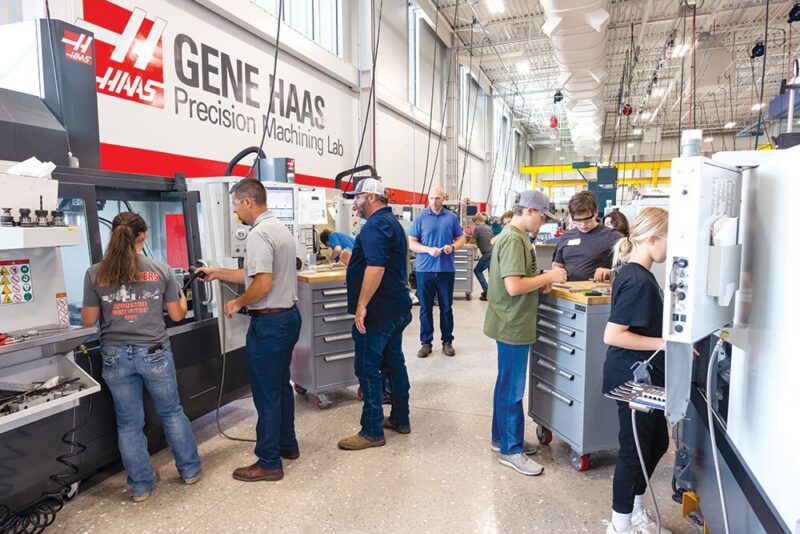
“We built the center to be a showcase and to help recruit the next generation,” said PMC Executive Director Robert Randolph. “So, we give a lot of field trips and tours. We’ve had thousands of students come through on tours; for instance, over 3,000 just last year. And that has really helped bolster our enrollment, and conversely, graduations.”
Randolph said almost 750 students from the college’s manufacturing and technology programs have graduated since the center opened. Additionally, he said Ozarks Tech has continued to stay in touch with local industry needs, noting automation and robotics and cybersecurity are newer programs added in response to workforce demands.
“We really intended the center not just to meet an immediate need, but to be flexible in meeting the needs of the future workforce as well,” he said.
Protoplex plan
Northeast of Ozarks Tech, along Interstate 44 in Rolla, Missouri University of Science and Technology is amid construction of a large-scale advanced manufacturing facility of its own. The Missouri Protoplex is a 117,000-square-foot facility intended to bring education and workforce development resources to manufacturers.
Richard Billo, director of the Missouri Protoplex and the Kummer Institute Center for Advanced Manufacturing, said the facility includes 40,000 square feet of high bay manufacturing space and will have seven corporate offices companies can lease to work alongside the university to develop new products and processes.
“The building will be officially turned over to us in February, and we’ll begin connecting up machines,” he said, adding an April 15 grand opening is planned. “I’ve got those machines scattered all over campus right now.”
The Protoplex is considered a research center, Billo said, adding The Boeing Co. (NYSE: BA) and Caterpillar Inc. (NYSE: CAT) are two companies that are planning to lease space.
“It’s a little bit different from a typical research center because this is a very outward focused building designed to work with the Missouri manufacturers,” he said. “It came about through a vision of an alumnus of ours. Fred Kummer and his wife, June, donated $300 million to Missouri S&T.”
Billo said the Kummers wanted a facility that focused on rebuilding U.S. manufacturing dominance
“That was the No. 1 mission. The No. 2 mission then was to provide a pipeline of a highly educated, highly skilled workforce to be able to work in these newly competitive manufacturing Missouri businesses,” Billo said. “And that’s what this facility’s there for.
It’s designed to work with the Missouri companies but also designed to help support the education of the engineering students.”
The Protoplex will be backed by Missouri S&T’s research centers, including the Kummer Institute Center for Advanced Manufacturing and Center for Aerospace Manufacturing Technology.
“The building’s not even open yet. We start moving equipment in February, but we started buying equipment, putting in temporary facilities around April 2022,” Billo said. “Since then, we have $23 million in funding with 16 active projects with companies.”
Billo said there’s great interest from students in the manufacturing engineering program, which offers master’s degrees and graduate certificates.
“Young people know where the jobs are,” he said.
“They’ve gravitated towards those courses because they know they’re going to get the skills that the companies are going to be looking for as they near graduation.”
In 2024, manufacturing represented nearly $52.4 billion of the state’s $451.2 billion gross state product, equating to 11.6%, according to the most recent annual data collected by the Missouri Economic Research and Information Center. Additionally, manufacturing accounted for 11.5% of the state’s private sector employment, resulting in 284,855 jobs across 8,429 establishments. Missouri’s annual manufacturing payroll totaled $21.2 billion in 2024, with an average annual wage of $74,553, well above the state’s overall private sector wage of $64,754.
Meeting needs
Founded in 1907, St. Louis-based Ranken Technical College offers two- and four-year degrees for students in programs including manufacturing. Aside from St. Louis, it has locations in Ashland, Perryville and Wentzville. Manufacturing courses include advanced precision machining technology, agricultural engineering technology and fabrication and welding.
“Ranken offers a range of manufacturing-related programs within its manufacturing division designed to prepare students for in-demand careers and advanced manufacturing and technical industries,” said Travis Hellmann, manufacturing integration and operations director. “We have automation technology. This combines classroom learning with paid internships, covering machine maintenance, hydraulics, pneumatics, robotics and electrical systems.
“It kind of prepares our students to troubleshoot factory and industrial automation,” he added.
Ranken partners with local employers such as General Motors Co. (NYSE: GM) and Boeing to ensure job placement for students, Hellman said.
“Many students complete internships with companies as part of their training and job placements,” he said. “they’ll do eight weeks in their second semester here at Ranken. Then the students will go out and find a company to do this internship with. Typically, that company will hire them when they graduate at their fourth semester. So, they get a lot of hands-on, real-world training with these companies.”
Hellman said manufacturing and related technical fields are critical to the regional and national economy.
“Employers in the St. Louis region are facing shortages of qualified skilled workers right now,” he said. “That seems to be a big topic around the world. Ranken programs help fill that gap by training students with hands-on skills that local industries need.”
Ozarks Tech’s Randolph agreed that manufacturing, like many industries, is suffering from a workforce shortage
“Recruiting that next generation has been critical,” he said. “That’s where initiatives like the Plaster Manufacturing Center can really come in and help on a regional basis by getting the next generation intrigued, excited and engaged with the possibility of training in manufacturing and entering that career field.”
Randolph said the PMC also is actively working with the current workforce. The college serves as a resource for companies looking to skill up its employees.
“As manufacturing facilities are adopting increased levels of automation, AI, robotics, things like that, those folks will need to be trained in those new skill sets,” he said.
Source: Educational Investments for Manufacturing Interest
https://sbj.net/stories/educational-investments,103453
Educational Investments – Higher ed institutions seek to bolster manufacturing interest across Missouri
Mike Cullinan, Reporter mcullinan@sbj.net
https://www.techedmagazine.com/category/industries/manufacturing/