
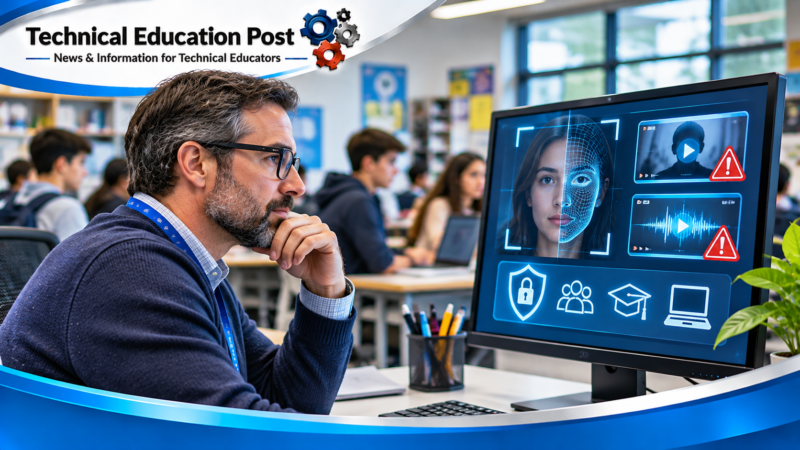
A new national survey finds that nine in ten educators have received no recent training on identifying or responding to AI-generated deepfakes, raising urgent questions about student safety, cyberbullying policies, and school preparedness.
Artificial intelligence is creating a new student safety challenge for K–12 schools, as increasingly accessible tools allow users to generate convincing fake images, videos, and audio recordings of students and educators.
New findings from the EdWeek Research Center reveal that many schools are struggling to establish policies and prepare teachers to respond when manipulated media is used for harassment, impersonation, or reputational harm.
In a nationwide survey of 852 educators conducted during summer 2026, approximately nine in ten respondents reported receiving no training during the previous two years on identifying or responding to deepfakes.
One-third said they did not know whether their school or district had a policy addressing AI-generated manipulated media. Another 22% reported that their institution had no such policy.
The findings, published by Education Week on November 4 and distributed through Government Technology on November 5, highlight a widening gap between the capabilities of generative AI and the preparedness of schools responsible for protecting students.
For district administrators, teachers, technology directors, and school boards, the issue extends beyond conventional cyberbullying. Deepfake incidents can involve serious privacy violations, sexual harassment, and potentially criminal conduct.
Key Takeaways
- Nine in ten educators reported no recent deepfake training, according to the EdWeek Research Center survey.
- One-third were uncertain about school policies addressing AI-generated manipulated media.
- Another 22% reported having no relevant policy at their institution.
- Deepfake harassment can cause serious harm, even when the images or recordings are fabricated.
- Schools need coordinated incident response procedures, not simply technology restrictions.
- Digital citizenship education should address consent, AI-generated media, reporting, and responsible technology use.
What the National Survey Reveals
The EdWeek Research Center surveyed 852 educators to understand how schools are preparing for the risks associated with AI-generated deepfakes.
The results reveal significant gaps in awareness, policy communication, and professional development.
| Survey finding | Reported result |
|---|---|
| Educators receiving no deepfake detection or response training in the past two years | Approximately 90% |
| Educators uncertain whether their institution has a deepfake policy | Approximately 33% |
| Educators reporting no relevant school or district policy | 22% |
| Educators unfamiliar with what a deepfake is | 13% |
| Educators reporting that a policy is under consideration | 2% |
These findings suggest that schools face two related challenges.
First, some districts have not established clear procedures for addressing harmful AI-generated content.
Second, even where policies exist, educators may not understand how those policies apply to incidents involving synthetic media.
That uncertainty can delay intervention when students need immediate assistance.
What Are Deepfakes, and Why Are They a School Safety Concern?
A deepfake is an image, video, or audio recording that has been generated or manipulated using artificial intelligence to create a misleading representation of a person.
Deepfakes can make individuals appear to say or do things that never occurred.
Some applications are harmless, including creative media production, educational simulations, and entertainment.
However, the same technology can be misused to impersonate individuals, fabricate inappropriate behavior, spread misinformation, or create nonconsensual intimate imagery.
Common Deepfake Risks in Schools
Student harassment: AI-generated images may falsely portray students in humiliating or compromising situations.
Nonconsensual intimate imagery: Synthetic sexual images can be created using photographs of students without their permission.
Educator impersonation: Fabricated recordings may depict teachers or administrators making offensive statements.
Reputational damage: Manipulated media can circulate rapidly through social platforms and messaging applications.
Extortion and intimidation: Threats involving fabricated images may be used to pressure or frighten students.
These incidents can have serious consequences regardless of whether the content is authentic.
A fabricated image can still cause emotional distress, social isolation, disciplinary disputes, and lasting reputational harm.
Students Are Already Encountering Deepfake Harassment
The problem is not limited to hypothetical future risks.
A 2024 survey by the Center for Democracy and Technology found that approximately one in four K–12 students knew someone who had been depicted in a nonconsensual, sexually explicit deepfake.
That finding illustrates the reach of the issue among young people.
The accessibility of generative AI tools compounds the problem.
Creating convincing manipulated media no longer necessarily requires advanced programming knowledge or expensive software.
In some cases, publicly available photographs and basic consumer applications can be misused to produce harmful synthetic content.
For educators, the resulting challenge is both technological and interpersonal.
Students need to understand that the ease of generating an image does not diminish the seriousness of distributing harmful material.
Why Existing Cyberbullying Policies May Not Be Enough
Many school districts already maintain policies addressing harassment, bullying, acceptable technology use, and student discipline.
These policies can provide a foundation for addressing deepfake incidents.
However, AI-generated media introduces circumstances that traditional policies may not explicitly anticipate.
For example, a school may have a clear prohibition against sharing an actual intimate photograph without consent but lack language addressing a fabricated image depicting the same conduct.
Similarly, existing procedures may not explain how educators should handle potentially illegal synthetic imagery involving minors.
Kristin Woelfel, policy counsel at the Center for Democracy and Technology, has emphasized that schools can incorporate deepfake provisions into existing technology, harassment, and cyberbullying policies rather than necessarily creating entirely separate policies.
The important issue is whether students and staff understand what conduct is prohibited and how incidents should be reported.
What Effective Policies Should Address
A comprehensive school policy should define harmful AI-generated media, prohibit nonconsensual manipulation and distribution, and establish procedures for reporting suspected incidents.
It should also explain how schools will protect affected students, evaluate potential misconduct, preserve appropriate evidence, and coordinate with relevant authorities.
Policies must be consistent with applicable federal and state laws.
Districts should consult legal counsel and child protection professionals when establishing procedures involving potentially illegal material.
Deepfake Detection Is Not the Same as Deepfake Response
A common assumption is that schools need sophisticated AI detection software to manage deepfake incidents.
Detection tools may assist with evaluating suspicious content, but they have limitations.
Generative AI systems continue to improve, and automated detectors can produce incorrect classifications.
A false positive could lead to an authentic recording being dismissed as fabricated.
A false negative could allow manipulated media to be treated as genuine.
For this reason, schools should avoid making disciplinary or other high-stakes decisions based solely on automated detection results.
More importantly, schools must recognize that a student can experience serious harm even when the offending image is synthetic.
The immediate priority should be protecting affected individuals and preventing further distribution.
What Teachers Should Do When a Deepfake Is Reported
Teachers are often the first adults students approach when harmful content begins circulating.
Districts should provide clear, practical guidance that does not require educators to become digital forensic specialists.
1. Respond Calmly and Take the Report Seriously
Students should feel comfortable reporting suspicious or harmful content.
Educators should avoid dismissing a complaint simply because an image appears to be fabricated.
2. Do Not Redistribute the Material
Teachers should not ask students to forward potentially explicit images to personal phones, personal email accounts, or informal messaging groups.
Material depicting minors in sexual situations may raise serious legal concerns, including when AI-generated.
3. Follow Established Reporting Procedures
Educators should contact the designated school administrator, safeguarding professional, or other appropriate authority.
Mandatory reporting obligations may apply depending on the circumstances and jurisdiction.
4. Protect the Student’s Privacy
Information should be shared only with personnel who have a legitimate need to respond.
Schools should avoid unnecessary discussion of the incident among students or staff.
5. Provide Appropriate Support
Affected students may need counseling, academic accommodations, family communication, or additional safety measures.
Schools should avoid responses that unnecessarily expose students to further embarrassment or retaliation.
Why Teacher Professional Development Is Essential
The survey’s finding that nine in ten educators had received no recent deepfake training suggests a substantial professional development opportunity.
Training should focus on practical competencies.
Teachers need to understand what deepfakes are, how harmful content can circulate, what warning signs may appear, and how to respond safely.
Professional development should also address the limitations of detection technology and the importance of student privacy.
Recommended Training Topics
| Training area | Essential competency |
|---|---|
| Deepfake awareness | Recognize common forms of manipulated media |
| Student safeguarding | Respond appropriately to reports of harmful content |
| Incident escalation | Know whom to contact and when |
| Privacy protection | Avoid unnecessary collection or distribution of sensitive images |
| Digital citizenship | Teach consent, ethical AI use, and responsible sharing |
| Family communication | Explain incidents accurately without increasing harm |
| Policy awareness | Understand applicable district rules and reporting obligations |
Short, scenario-based professional development sessions may be more useful than general presentations about artificial intelligence.
Educators should have opportunities to practice responding to realistic situations.
The Role of Digital Citizenship Education
Preventing deepfake harassment requires more than disciplinary consequences.
Students need explicit instruction about consent, privacy, authenticity, and the ethical use of generative AI.
Digital citizenship lessons should explain that manipulating another person’s likeness can cause harm even when the resulting image is fictional.
Students should also learn to question suspicious media and avoid amplifying harmful content.
Teaching Responsible AI Use
Age-appropriate lessons can address several questions:
- What makes an image or recording trustworthy?
- Why is consent important when using another person’s likeness?
- What should students do when they receive suspicious or harmful media?
- How can manipulated content affect someone’s reputation?
- What responsibilities do individuals have before sharing digital information?
These discussions can connect AI literacy with broader lessons involving empathy, respect, privacy, and online behavior.
School Leaders Need a Coordinated Incident Response Plan
A deepfake incident can involve multiple departments.
School administrators may need to coordinate with counselors, technology staff, legal advisers, communications personnel, and law enforcement.
Without an established plan, responses can become inconsistent or delayed.
A coordinated response plan should establish clear responsibilities before an incident occurs.
Recommended District Response Framework
Identification: Provide students and staff with a safe reporting channel.
Initial assessment: Determine whether immediate student protection or mandatory reporting is necessary.
Containment: Take appropriate steps to limit further distribution without unnecessarily copying sensitive material.
Student support: Provide counseling and other assistance to affected individuals.
Investigation: Follow lawful, documented procedures that protect student rights and privacy.
Communication: Inform families and relevant stakeholders as appropriate.
Follow-up: Evaluate whether additional student support, policy changes, or staff training are needed.
The response should be proportionate to the incident and consistent with applicable law.
Legal and Policy Considerations
Deepfake-related misconduct can implicate multiple legal frameworks.
Depending on the circumstances, relevant issues may include harassment, privacy, civil rights, child protection, and criminal law.
The federal TAKE IT DOWN Act, enacted in 2025, addresses certain nonconsensual intimate images, including qualifying AI-generated depictions.
Schools should not assume that every manipulated image constitutes a federal crime.
The legal analysis depends on the nature of the material, the conduct involved, and applicable law.
Districts should seek qualified legal guidance when developing policies or responding to serious incidents.
What Administrators Should Do in the Next 30 Days
School leaders can take meaningful steps without waiting for another incident.
Week 1: Review policies. Examine existing harassment, bullying, acceptable-use, and student safety policies for coverage of AI-generated media.
Week 2: Establish response procedures. Identify designated contacts, escalation requirements, and privacy safeguards.
Week 3: Train staff. Provide practical guidance on recognizing, reporting, and responding to harmful deepfakes.
Week 4: Communicate expectations. Explain district policies to students and families using clear, age-appropriate language.
Districts should also review vendor policies governing AI-enabled educational platforms and student information.
Frequently Asked Questions
What is a deepfake in education?
A deepfake is AI-generated or manipulated media that falsely depicts a student, educator, or another individual saying or doing something.
How many educators have received deepfake training?
In the EdWeek Research Center’s 2026 survey, approximately nine in ten respondents reported no training on identifying or responding to deepfakes during the previous two years.
Do schools need a separate deepfake policy?
Not necessarily. Existing harassment, bullying, and technology-use policies may be updated to explicitly address AI-generated manipulated media.
Can schools use AI detection software?
Detection tools may provide useful information, but their results should not be treated as definitive proof of authenticity.
What should teachers do if a student reports an explicit deepfake?
Teachers should follow safeguarding and reporting procedures, avoid redistributing the material, and involve appropriate school personnel.
Are AI-generated intimate images illegal?
Certain nonconsensual intimate depictions, including qualifying AI-generated material, may violate federal or state law. The specific legal requirements depend on the circumstances.
How can schools prevent deepfake harassment?
Schools can strengthen policies, train educators, teach digital citizenship, establish reporting procedures, and provide appropriate student support.
Why is consent important in AI education?
Consent helps students understand that using another person’s image, voice, or likeness can affect their privacy, dignity, and safety.
TechEd Magazine Perspective
The growing use of AI-generated deepfakes represents a significant test of school preparedness.
The challenge is not simply whether educators can identify manipulated images.
It is whether schools have established the policies, training, and support systems necessary to respond when students or staff are harmed.
The EdWeek Research Center findings suggest that many institutions remain underprepared.
However, effective solutions do not necessarily require expensive technology or entirely new administrative structures.
Schools can begin by strengthening existing safety policies, providing practical staff training, establishing coordinated incident procedures, and teaching students the importance of consent and responsible digital behavior.
As generative AI becomes more capable, protecting students will require continued attention to both technological developments and the human consequences of misuse.
The institutions best prepared for this challenge will be those that treat AI safety as an essential part of student well-being rather than an isolated technology problem.
Sources and Further Reading
Original research and reporting
Education Week, November 4, 2026:
Fake AI Images Are Targeting Students and Teachers. Schools Aren’t Prepared
November 5 reporting
Government Technology:
Deepfake Cyber Bullying Outpaces Teacher Training, Policies
Additional organizations and resources
Center for Democracy and Technology
U.S. Department of Education — Student Privacy
National Center for Missing & Exploited Children — CyberTipline
StopNCII.org — Nonconsensual Intimate Image Support for Adults