
For decades, the dominant American education pathway has been relatively easy to describe: finish high school, enroll in college, earn a degree and then enter the workforce.
A new national coalition is arguing that the transition from education to employment needs considerably more options—and much stronger connections between schools and employers.
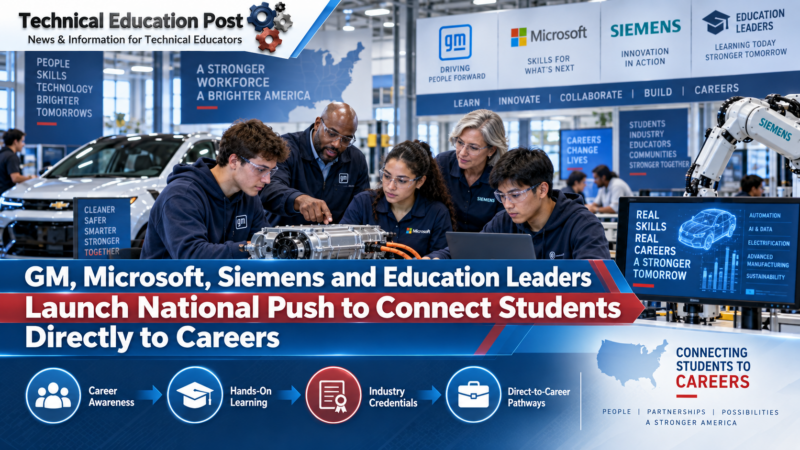
On September 10, the American Federation of Teachers, CareerWise and Jobs for the Future launched the Compact for America’s Youth, bringing together employers, labor organizations, educators, workforce groups and philanthropies around a common goal: creating clearer pathways from school into careers at a time when artificial intelligence is rapidly changing entry-level work.
The initial commitments are substantial and unusually diverse.
General Motors is committing $500,000 to introduce middle-school students in Detroit and Dearborn to advanced manufacturing careers. The Siemens Foundation is investing $2 million to expand radiologic technologist apprenticeships. The Walton Family Foundation is putting $5 million into an Apprentice Ready Schools initiative expected to reach at least 30,000 students. Microsoft and North America’s Building Trades Unions are introducing an AI-powered tool designed to help students find Registered Apprenticeships. And Jobs for the Future and LinkedIn are investing $400,000 to study how AI is changing entry-level jobs.
Individually, these are workforce programs.
Collectively, they point toward something more consequential: an effort to build a more coherent early-career infrastructure connecting K–12 education, postsecondary education, employers, unions, apprenticeships and the workforce.
Key Takeaways
The Compact for America’s Youth is not one national program. Its organizers describe it as a framework through which participating organizations make public, measurable commitments around career-connected learning and early-career outcomes. Its four pillars are expanding opportunity, investing in the future workforce, building better systems and leading with accountability.
Among the first commitments:
- General Motors: $500,000 for Manufacturing Futures, connecting middle-school students at nine Detroit and Dearborn schools with advanced manufacturing careers.
- Siemens Foundation: $2 million to expand CareerWise radiologic technologist apprenticeships into two additional cities.
- Walton Family Foundation: $5 million for Apprentice Ready Schools, targeting up to 60 districts and charter networks and at least 30,000 students.
- JFF + LinkedIn: $400,000 for a one-year investigation of how AI is reshaping early-career jobs and required skills.
- Microsoft + NABTU: Jobs Machine, an AI-powered resource intended to help students, families and job seekers understand and enroll in Registered Apprenticeships in construction.
- AFT: $150,000 in Career Pathways Partnership Grants for work-based learning, employer partnerships, middle-school career exposure and CTE activities.
- AFL-CIO Working for America Institute + AFT: exploration of a Manufacturing Core Curriculum pilot for high-school students in up to three locations in 2027.
The larger question is whether initiatives like these can transform a collection of disconnected education and workforce programs into pathways students can actually navigate.
The Compact Is About Infrastructure, Not Another Program
The distinction matters.
The Compact’s organizers explicitly say it is not a single program intended to be replicated nationally. Instead, it is meant to provide a framework for aligning systems that frequently operate independently: K–12 education, higher education, workforce development, labor and industry.
That addresses a problem Technical Education Post has examined in its coverage of CTE and Workforce Development.
America does not lack education programs.
It has CTE programs.
It has workforce boards.
It has community colleges.
It has Registered Apprenticeships.
It has internships.
It has dual enrollment.
It has industry credentials.
It has employer training.
The persistent challenge is connecting them.
A student can complete a CTE program without entering an apprenticeship. An employer can struggle to hire technicians while remaining largely disconnected from nearby schools. A workforce agency can fund training that does not articulate into a college credential. A student can earn a credential without understanding which employers recognize it.
The Compact is attempting to address the spaces between those systems.
Four Pillars Define the Strategy
The Compact organizes commitments around four areas.
Expand Opportunity
Partners are encouraged to increase access to apprenticeships, internships, CTE, dual enrollment, mentoring and other career-connected learning experiences.
Invest in the Future Workforce
Employers and other organizations can contribute funding, equipment, technology, staff expertise, paid work experiences or other resources.
Build Better Systems
This pillar focuses directly on eliminating barriers among K–12 schools, colleges, workforce organizations, labor and industry.
Lead With Accountability
Participating organizations are expected to establish measurable objectives, publicly report progress and share lessons from their work.
That last pillar could ultimately determine whether the Compact becomes significant.
Education and workforce development have no shortage of announcements.
The important question is what happens afterward.
GM Is Starting the Manufacturing Pipeline in Middle School
One of the most interesting commitments comes from General Motors.
GM is committing $500,000 to Manufacturing Futures, an AFT initiative launching during the current school year.
The program will expose middle-school students to advanced manufacturing careers across nine schools in Detroit Public Schools Community District and Dearborn Public Schools.
The age group is significant.
Manufacturing workforce strategies increasingly recognize that waiting until 11th or 12th grade to introduce technical careers may be too late. By then, students may already have developed strong assumptions about which careers are desirable, which require college and what manufacturing work looks like.
Manufacturing Futures moves career awareness upstream.
Students can encounter advanced manufacturing before they have selected a high-school pathway.
That mirrors a broader trend Technical Education Post has been following: manufacturing workforce development is beginning earlier, while the industry itself becomes more dependent on robotics, automation, digital systems, AI and other advanced technologies.
It also creates a possible progression:
Middle-school exposure → high-school CTE → industry credential → work-based learning → apprenticeship or postsecondary education → advanced manufacturing employment
The key is whether institutions deliberately connect those stages.
AFT Is Funding Local Career Pathways
The AFT is putting another $150,000 behind the strategy through its new Career Pathways Partnership Grants.
Individual awards can reach $15,000, with most expected to fall between $10,000 and $15,000. The union expects to support approximately 10 to 15 projects.
The projects can include work-based learning, partnerships between employers and higher education, middle-school career exploration and classroom robotics or CTE clubs.
The dollar amount is modest compared with large federal workforce grants.
But the design is notable because it gives local organizations flexibility to create relatively small interventions that can become entry points into larger pathways.
A robotics club, for example, may seem distant from workforce development.
But if it leads to a high-school automation program, dual enrollment in mechatronics, an internship and eventually an apprenticeship, it becomes the first stage of a career pathway.
The important question is whether those connections are intentionally built.
Microsoft and the Building Trades Want Apprenticeship to Be Easier to Navigate
Another problem is not the absence of apprenticeship opportunities but the difficulty students can have discovering and understanding them.
Microsoft and North America’s Building Trades Unions announced Jobs Machine, an AI-powered tool designed to help students, parents and job seekers understand and enroll in Registered Apprenticeship programs in construction.
The concept addresses an important information imbalance.
Students interested in traditional higher education generally know where to begin.
They can search colleges, compare majors, examine admissions requirements, complete standardized applications and receive extensive guidance from school counselors.
Apprenticeship pathways can be considerably harder to navigate.
Different trades have different programs.
Eligibility requirements vary.
Sponsors vary.
Application processes vary.
Opportunities can be highly local.
NABTU’s stated objective is to make apprenticeship pathways easier for students and families to navigate, more like the information environment surrounding college options.
That could matter substantially if apprenticeship is expected to become a mainstream postsecondary pathway rather than a specialized option understood primarily by families already familiar with the trades.
Apprentice Ready Schools Could Connect High Schools Directly to Employers
The largest initial education investment comes from the Walton Family Foundation, which is committing $5 million to CareerWise for a national Apprentice Ready Schools initiative.
The effort is expected to involve as many as 60 school districts and charter networks and reach at least 30,000 students.
Its objective is particularly important: create direct connections between high schools and industry partners so schools can design, strengthen and scale apprenticeship and work-based learning.
That could change the role of career preparation inside high schools.
A school can offer excellent CTE courses while still leaving students to navigate the transition into employment largely on their own.
An apprenticeship-ready model requires more.
Employers need to participate.
Schedules may need to accommodate work.
Students need career navigation.
Programs need alignment with actual occupations.
Schools need mechanisms for connecting learners with paid opportunities.
And someone has to coordinate the system.
That last function is increasingly being handled by intermediaries such as CareerWise.
Siemens Is Applying Apprenticeship to Healthcare
The Compact also demonstrates why apprenticeship should not be understood solely as a construction or manufacturing model.
The Siemens Foundation is committing $2 million to expand CareerWise’s radiologic technologist apprenticeship work into two additional cities.
The investment builds on healthcare apprenticeship work already underway in New York City through the FutureReadyNYC Healthcare Pathway Accelerator.
That is important because healthcare faces many of the same workforce challenges as manufacturing and the skilled trades.
Employers need technically skilled workers.
Education can be expensive.
Clinical and practical experience matter.
Students benefit from a clearer connection between training and employment.
Apprenticeship offers a mechanism for combining structured education with paid work.
If models like this expand successfully, Registered Apprenticeship could increasingly become an education strategy across healthcare, IT, manufacturing and other technical fields rather than remaining associated primarily with traditional trades.
AI Is Changing the Entry-Level Job
The Compact is also responding to a problem that did not exist in the same form a few years ago: artificial intelligence may change the first rung of the career ladder.
JFF and LinkedIn are investing $400,000 in a one-year initiative examining how AI is reshaping early-career jobs and pathways, what skills young workers need and how education and workforce practitioners should respond.
This could become one of the Compact’s most important research components.
Entry-level work traditionally performs two functions.
It produces value for an employer.
But it also trains inexperienced workers.
A junior employee may perform relatively routine tasks while learning the occupation, building professional judgment, developing networks and gaining the experience necessary for more complex responsibilities.
AI can automate precisely some of those routine tasks.
That creates a difficult workforce-development question:
If AI removes some traditional entry-level work, how will young people acquire the experience required for higher-level work?
The answer cannot simply be “teach everyone AI.”
Young workers still need occupational knowledge, communication, problem solving, judgment and real experience inside organizations.
The challenge is redesigning early-career pathways around work that remains valuable as AI changes task composition.
The Years From 16 to 26 Are Becoming a Policy Focus
The Compact describes ages 16 through 26 as a critical “launchpad” period in which young people accumulate education, experience, professional networks and other resources that can influence their long-term economic trajectory.
That framing is useful for technical educators.
Traditional systems often divide this period institutionally.
K–12 owns the first part.
Higher education owns another.
Workforce organizations serve particular populations.
Employers take responsibility after hiring.
Apprenticeship operates through another structure.
But a young person experiences those years as one continuous transition.
The institutions may be fragmented.
The student’s life is not.
A stronger early-career system therefore needs to follow the learner across institutional boundaries.
The Alternative Is Not “College or Career”
This is where the Compact needs careful interpretation.
The emerging school-to-career movement should not become another version of the old debate over whether students should pursue college or vocational education.
Modern technical careers make that distinction increasingly unhelpful.
A student may:
complete high-school CTE → enter an apprenticeship → earn college credit → complete an associate degree → work → return for a bachelor’s degree
Another may:
complete dual enrollment → earn an industry credential → attend community college → enter advanced manufacturing
Another might:
enter healthcare apprenticeship → earn occupational credentials → continue into higher-level healthcare education
Career-connected education should increase students’ options rather than narrow them.
The Compact itself frames pathways as potentially leading to college, career or both.
That principle matters.
The strongest workforce systems do not create educational ceilings.
They create multiple entry points and multiple opportunities for advancement.
Technical Education Post explored that same concern in How Industrial Policy Is Reshaping CTE: short-term workforce programs are most valuable when they become entry ramps into continued credentials, apprenticeships, degrees and career advancement rather than terminal destinations.
Manufacturing Could Be One of the Biggest Beneficiaries
The manufacturing components of the Compact deserve particular attention.
GM’s Manufacturing Futures initiative introduces students to advanced manufacturing in middle school.
The Working for America Institute and AFT are exploring use of the Manufacturing Core Curriculum, or MC2, with high-school students in as many as three locations beginning in 2027.
Those efforts could connect with a much larger manufacturing workforce ecosystem involving CTE centers, community colleges, apprenticeships and employers.
The challenge is ensuring that students see modern manufacturing as it actually exists.
Today’s production environments increasingly involve robotics, CNC equipment, automation, sensors, quality systems, digital manufacturing, industrial controls and sophisticated maintenance.
Career exposure needs to reflect that reality.
Otherwise, programs risk recruiting students into an image of manufacturing that disappeared decades ago.
What Makes This Different From Another Workforce Coalition?
Coalitions are easy to announce.
Systems are difficult to change.
The Compact has several characteristics that make it worth following.
First, organizations are being asked to make specific commitments, rather than simply endorse general principles.
Second, the commitments cross industries.
Manufacturing, healthcare, construction, technology and education are all represented.
Third, the framework explicitly targets the institutional boundaries separating K–12, higher education, workforce systems and employers.
Fourth, accountability is one of its four formal pillars. Participating organizations are expected to establish goals and report progress.
But those characteristics do not guarantee success.
The real test begins now.
What Success Should Look Like
The Compact should ultimately be evaluated by outcomes rather than dollars pledged.
Useful measures would include:
How many students receive meaningful career exposure?
How many complete paid work-based learning?
How many enter Registered Apprenticeship?
How many participating employers actually hire young people?
How many students earn credentials with labor-market value?
How many pathways provide college credit?
How many participants remain employed after one or two years?
What are their wages?
Do students have opportunities to continue their education?
Do historically disconnected systems become easier for students to navigate?
Those measures are harder than counting program participants.
They are also considerably more meaningful.
A New School-to-Career Infrastructure May Be Emerging
Taken together with other recent developments, the Compact looks less isolated.
Federal policy is placing renewed attention on Registered Apprenticeship and effective pre-apprenticeship.
States are investing in apprenticeship intermediaries.
Community colleges are increasingly becoming apprenticeship sponsors.
Manufacturers are introducing students to technical careers earlier.
Employers are investing directly in career-connected education.
AI is increasing pressure to rethink early-career work.
And schools are being asked to provide students with pathways that connect learning more directly to economic opportunity.
A new model is beginning to become visible:
Middle-school career exploration → high-school CTE and dual enrollment → work-based learning → pre-apprenticeship → Registered Apprenticeship or postsecondary technical education → employment → continued education and advancement
Not every student will follow that sequence.
Nor should they.
But having a sequence that students can actually see and navigate is an improvement over asking young people to assemble the pieces themselves.
Questions to Ask Your Program
When do students first encounter career exploration?
Waiting until senior year is increasingly difficult to justify.
Can students see a pathway beyond our CTE program?
They should know which credentials, apprenticeships, colleges and employers come next.
Do we offer paid work-based learning?
Career exposure and actual workplace experience are not the same thing.
Are employers structural partners or occasional visitors?
Strong pathways require employers to participate in program design and work-based learning.
Can apprenticeship count toward postsecondary education?
Students should not have to choose unnecessarily between employment and continued education.
Do counselors understand Registered Apprenticeship?
Students cannot select pathways they are never shown.
Are we preparing students for AI-altered entry-level work?
Programs should examine how AI is changing tasks inside the occupations they serve.
Are outcomes measured beyond graduation?
Employment, wages, apprenticeship completion, credential attainment and continued education provide a clearer picture of pathway quality.
What to Watch Next
Several commitments now have measurable targets.
Manufacturing Futures should reach students across nine Detroit-area schools.
AFT expects to award up to $150,000 through its Career Pathways Partnership Grants.
Apprentice Ready Schools is targeting as many as 60 districts and charter networks and at least 30,000 students.
Siemens Foundation funding is expected to bring CareerWise’s radiologic technologist apprenticeship model into two additional cities.
JFF and LinkedIn have a one-year window for their research on AI and early-career work.
And the Working for America Institute/AFT manufacturing curriculum initiative could reach up to three pilot locations in 2027.
Those targets give educators something concrete to monitor.
The larger question will take longer to answer:
Can these separate commitments begin functioning as a system?
Frequently Asked Questions
What is the Compact for America’s Youth?
The Compact for America’s Youth is a cross-sector national framework launched by AFT, CareerWise and Jobs for the Future to strengthen pathways between education and careers. It brings together education, employers, labor, workforce organizations and philanthropy around measurable commitments.
Is the Compact a new federal program?
No. Its organizers explicitly describe it as a framework for coordinated public- and private-sector action rather than a single program intended to be scaled nationally.
What is General Motors funding?
GM is committing $500,000 to Manufacturing Futures, which will expose middle-school students across nine Detroit and Dearborn schools to advanced manufacturing careers.
What is Apprentice Ready Schools?
CareerWise is launching the initiative with a $5 million Walton Family Foundation investment. It is intended to connect high schools directly with industry partners across as many as 60 districts and charter networks, reaching at least 30,000 students.
What is the Jobs Machine?
Jobs Machine is an AI-powered tool announced by Microsoft and North America’s Building Trades Unions to help students, families and job seekers understand and enroll in Registered Apprenticeship programs in the construction trades.
What is Siemens Foundation funding?
The Siemens Foundation is committing $2 million to expand CareerWise’s radiologic technologist apprenticeship model into two additional cities.
How does AI fit into the Compact?
AI is treated as one of the forces changing early-career work. JFF and LinkedIn are conducting a $400,000, one-year project examining how AI is changing entry-level jobs, skills and pathways.
What are the Compact’s four pillars?
They are Expand Opportunity, Invest in the Future Workforce, Build Better Systems and Lead with Accountability.
Technical Education Post Perspective
The most important idea behind the Compact for America’s Youth is not that every young person should enter an apprenticeship.
It is that every young person should have a visible route from education into adulthood.
For too many students, the system still provides detailed instructions for entering college and comparatively little guidance about what happens if they want to enter advanced manufacturing, healthcare technology, construction, cybersecurity or another technical field through a different route.
That imbalance matters even more as AI changes entry-level work.
Students need earlier exposure to occupations.
They need authentic workplace experience.
They need credentials employers recognize.
They need apprenticeships and postsecondary programs that connect rather than compete.
And they need pathways that allow them to continue learning after they begin working.
The Compact is not yet proof that the United States has built such a system.
It is evidence that major organizations increasingly recognize the absence of one.
The commitments from GM, Microsoft, Siemens Foundation, AFT, CareerWise, JFF and others now create something measurable.
That is where Technical Education Post should keep its attention.
If these investments produce stronger connections among middle schools, high-school CTE, employers, apprenticeships and postsecondary education, the Compact could become more than another workforce initiative.
It could help establish a different expectation:
Students should not graduate and then begin looking for a pathway.
The pathway should already be there.
Recommended Reading
CTE and Workforce Development — Why CTE and workforce systems are most effective when education connects directly with credentials, employers and economic opportunity.
How Industrial Policy Is Reshaping CTE — How apprenticeships, workforce policy and industry investment are changing technical education.
America’s Advanced Manufacturing Workforce — How automation and emerging technologies are changing manufacturing occupations and technical skill requirements.
High School CTE Data Reveals Career-Readiness Gaps — Analysis of the challenge of creating clearer education-to-career pathways.
Sources
CareerWise — Compact for America’s Youth Launch Announcement — Primary source detailing the Compact and its initial employer, labor, education and philanthropic commitments.
American Federation of Teachers — Compact Launch — Primary organizer source for the September 10 launch and individual commitments.
Compact for America’s Youth — National Forum and Framework — Official explanation of the Compact’s purpose and early-career infrastructure strategy.
Compact for America’s Youth — Four Pillars — Official framework covering opportunity, investment, systems alignment and accountability.
AFT Career Pathways Partnership Grants — Program details for the $150,000 local career-pathway grant initiative.