
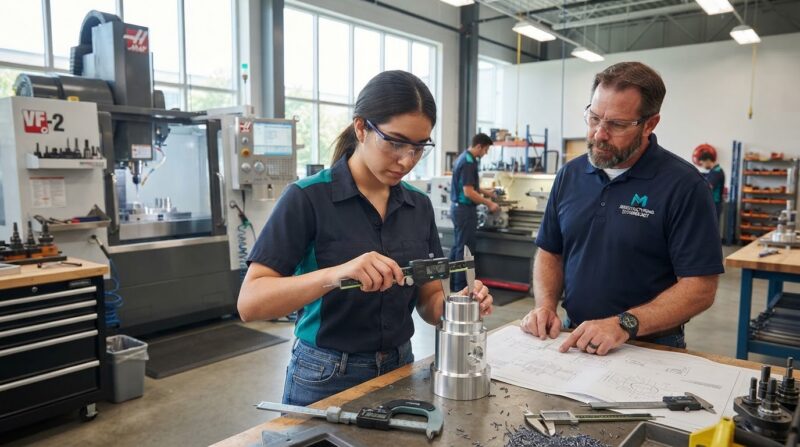
Cape Fear Community College’s partnership with SME will introduce a new manufacturing certification program in January 2027 while strengthening connections between technical education and employers.
Cape Fear Community College in Wilmington, North Carolina, has formally launched a partnership with SME, the national manufacturing organization, to expand technical training and strengthen regional workforce development.
The partnership was launched during the college’s November 19 advanced manufacturing expo, with additional details reported November 20. The initiative connects the college with SME’s Manufacturing Imperative – Workforce Pipeline Coalition, a national network working to improve manufacturing education and employment pathways.
The partnership also includes plans for a new Certified Manufacturing Associate program scheduled to begin in January 2027. For career and technical education institutions, the development illustrates a model for connecting classroom instruction, industry-recognized skills and sustained employer participation.
New Manufacturing Certification Begins in January
Cape Fear Community College’s upcoming Certified Manufacturing Associate program will introduce students to essential competencies required in modern manufacturing environments.
The curriculum includes technical mathematics, precision measurement, engineering graphics and workplace safety. These subjects form the foundation of many manufacturing occupations, including machining, industrial maintenance, production technology and quality assurance.
Precision measurement, for example, is important because manufactured components must satisfy specified dimensions and tolerances. Engineering graphics help technicians interpret drawings and communicate production requirements. Manufacturing mathematics supports calculations involving dimensions, material quantities, processes and quality control.
Although these concepts may appear basic compared with robotics and automated manufacturing, they are essential to developing workers capable of understanding increasingly sophisticated equipment.
Partnership Connects Colleges and Manufacturers
SME’s Manufacturing Imperative – Workforce Pipeline Coalition brings together educational institutions and industry organizations to address workforce needs.
According to the college, the broader initiative aims to help at least 75,000 people secure manufacturing employment, with a projected economic impact of $6 billion. Those figures represent coalition goals and projections, rather than employment results already achieved.
The network spans multiple states, with recent reporting describing participating institutions across 21 states.
Participation gives Cape Fear Community College access to a wider community of educators and manufacturing partners that can exchange instructional practices, share resources and explore solutions to common training challenges.
Those challenges include obtaining equipment, recruiting qualified instructors and maintaining relationships with employers after students enter training programs.
Building on Existing Technical Programs
Cape Fear Community College already offers eight advanced manufacturing-related programs: mechanical engineering technology, electronics engineering technology, mechatronics engineering technology, computer-integrated machining, welding technology, nuclear technology, chemical technology and biotechnology.
The new certification pathway may help introduce learners to manufacturing before they pursue more specialized technical programs. It also creates opportunities for the college to strengthen connections among introductory instruction, advanced training and employment.
The practical value of those connections depends on whether students understand how one educational experience prepares them for the next.
A student beginning with manufacturing fundamentals, for example, might later explore machining, automation, electronics or industrial maintenance. Clear pathways can help students make informed decisions about their training while giving employers a better understanding of graduates’ skills.
Employer Participation Is Central to the Model
One of the most important elements of the partnership is its emphasis on maintaining relationships with regional manufacturers.
Industry involvement can help technical programs identify which skills are currently needed and which technologies are becoming more important. Employers can also support instructional activities through facility visits, advisory committees, equipment demonstrations, internships and other forms of collaboration.
However, effective partnerships require more than occasional meetings. They benefit from ongoing communication about curriculum, student preparation, instructor development and employment outcomes.
The SME network is intended to help participating institutions strengthen these relationships and learn from other colleges facing similar challenges.
What Other Technical Colleges Can Learn
Cape Fear Community College’s initiative reflects a larger opportunity for manufacturing education. Technical institutions do not necessarily need to develop every curriculum, industry relationship or workforce strategy independently.
National partnerships can provide a framework for exchanging expertise while allowing individual colleges to respond to regional economic conditions.
The success of the new program will ultimately depend on enrollment, student learning, credential attainment and graduates’ opportunities for continued education or employment.
For community colleges and CTE administrators, the initiative offers another example of how manufacturing education can evolve from individual courses into connected, industry-supported career pathways.
Sources: Cape Fear Community College, November 11, 2026; WilmingtonBiz, November 20, 2026.