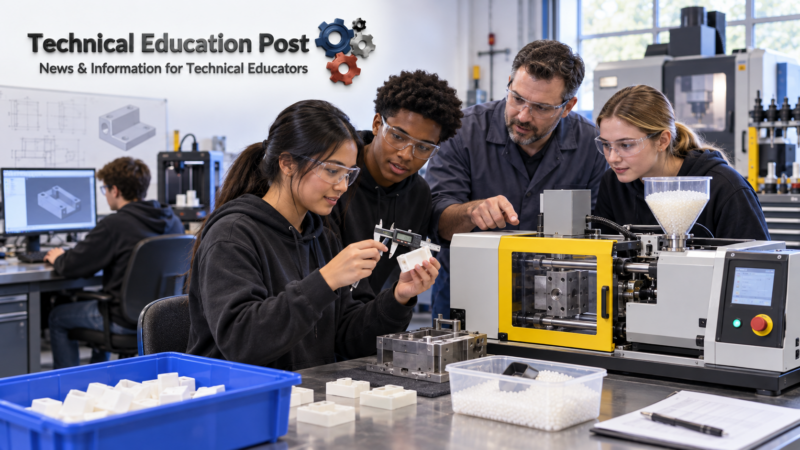
At the Cherry Creek Innovation Campus in Centennial, Colorado, students in the aerospace manufacturing pathway are learning something that is easy to overlook in a school makerspace: producing a part is not the same thing as producing a good part repeatedly.
Students already work with technologies including CNC machining, automation, robotics, additive manufacturing and precision measurement. One part of the program extends that experience into plastic injection molding, using compact benchtop equipment to let students install molds, select materials, establish processing parameters, produce parts, diagnose defects and evaluate quality. Cherry Creek describes its Aerospace Manufacturing pathway as preparation for production environments, with instruction spanning additive and subtractive manufacturing, automation, data analysis, quality control and advanced machinery.
The equipment in this particular lab is supplied by APSX Machines, whose compact APSX-PIM systems have been used at the school since 2019, according to a company case study. But the larger story is not about one machine.
It is about a change in what hands-on manufacturing education can teach.
As production equipment becomes smaller, more automated and more accessible, high schools and technical colleges can increasingly move students beyond making prototypes and into understanding production processes.
That distinction matters.
Key Takeaways
- Benchtop injection molding can expose students to production variables that are difficult to teach through additive manufacturing alone.
- Cherry Creek Innovation Campus uses compact injection molding as part of a broader aerospace manufacturing pathway that includes CNC, additive manufacturing, automation and quality control.
- The educational value is not simply producing plastic parts. Students learn setup, process control, material behavior, troubleshooting, inspection and repeatability.
- Compact machines can make production-oriented instruction accessible to labs that cannot accommodate full-scale industrial presses.
- Educators should evaluate safety, ventilation, tooling, curriculum, instructor preparation and total lab costs—not simply machine footprint.
- As manufacturing becomes more automated, students need deeper process knowledge rather than less of it.
From CAD Model to Production Process
Many school manufacturing labs begin with CAD and additive manufacturing.
That makes sense.
3D printing allows a student to design something digitally and hold a physical version of it a few hours later. It provides an accessible introduction to tolerances, geometry, materials, iteration and design thinking.
But production manufacturing introduces another layer.
A part may look correct in CAD and still be difficult to manufacture efficiently.
A mold may fill incompletely.
Too much material may create flash.
Temperature can affect flow.
Cooling time can affect dimensions.
Wall thickness can change how a part behaves.
Gate placement, runner geometry, draft, shrinkage and mold orientation all influence the finished product.
That is where injection molding can become particularly useful as an instructional tool.
At Cherry Creek, instructor Gabriel Roussere has students move through a manufacturing rotation that includes operating the injection molding equipment. According to APSX’s account of the program, students work in pairs, prepare the machine, run molds and examine the resulting parts.
As Roussere described the learning process:
“They learn that filling a mold properly requires some trial and error.”
That trial and error is not a failure of the lesson.
It is the lesson.
The Difference Between Making One Part and Making the Same Part Again
One of the most important concepts students can encounter in manufacturing education is repeatability.
A successful prototype proves that something can be made.
Production asks harder questions:
Can it be made again?
Can it be made within tolerance?
Can another operator reproduce the process?
Can a defect be traced to a specific variable?
Can the process be documented?
Can cycle time be improved without degrading quality?
Can the correct material be identified and processed consistently?
Those questions begin moving students from a maker mindset toward a manufacturing mindset.
APSX’s education curriculum, for example, includes lessons in material properties, processing temperature, pressure, mold design, draft, wall thickness, gates, runners, cycle time, inspection, dimensional accuracy and defects such as flash and sink marks. The curriculum also requires safety instruction before machine operation.
The specific platform is less important than the instructional sequence.
A strong production-oriented lab should ask students to:
- Define the part requirements.
- Design for manufacturability.
- Select an appropriate material.
- Prepare the tooling.
- Establish processing parameters.
- Run a first article.
- Inspect the result.
- Identify defects.
- Adjust the process.
- Produce another part.
- Compare results.
- Document what changed.
That is much closer to what technicians, manufacturing engineers and production teams actually do.
Why Benchtop Equipment Changes What Schools Can Teach
Traditional injection molding equipment can pose obvious challenges for educational programs.
Large presses require substantial floor space and can require specialized electrical infrastructure, auxiliary equipment, water systems, material-handling systems, guarding and significant capital investment.
Compact equipment reduces some of those barriers.
APSX currently describes its PIM V3 as an all-electric system with an approximately 4-foot-by-1-foot machine footprint. The company says it operates on standard electrical service and supports aluminum as well as certain 3D-printed mold inserts. Its current education package adds equipment including fume extraction, a drying oven, teaching molds, materials and setup assistance.
This is not unique to APSX.
Other manufacturers have entered the benchtop injection molding category. Plastics Machinery & Manufacturing, for example, reported this year on Polymer Dynamics’ Maverick 9T, another compact automatic injection molding system capable of using conventional resins and 3D-printed tooling.
That is important from an educator’s perspective because it means schools should think about benchtop molding as an equipment category, not simply as a particular vendor.
Systems can differ substantially in:
- clamping force;
- injection capacity;
- electrical requirements;
- machine controls;
- automation;
- tooling compatibility;
- safety systems;
- resin capability;
- data collection;
- ventilation requirements;
- cycle time;
- training;
- curriculum support;
- and cost.
The purchasing question should therefore begin with the learning objectives.
Start With the Competencies, Not the Machine
An educator evaluating injection molding equipment should first ask:
What do we want students to be able to do?
If the objective is simply to demonstrate that melted polymer can be formed inside a mold, relatively simple equipment may accomplish the goal.
If the objective is to teach production manufacturing, the requirements become different.
Students may need to understand:
- process windows;
- temperature control;
- material drying;
- injection parameters;
- cycle-time optimization;
- mold installation;
- part ejection;
- dimensional inspection;
- first-article approval;
- defect analysis;
- statistical variation;
- process documentation;
- preventive maintenance;
- safety procedures;
- and design for manufacturing.
The machine becomes a teaching platform for those competencies.
That approach also makes it easier for educators to evaluate different manufacturers at events such as IMTS.
Rather than asking, “What does this machine do?”
ask:
“What could my students learn by operating this machine?”
3D Printing and Injection Molding Should Not Be Treated as Competitors
The educational discussion sometimes creates an unnecessary choice between additive manufacturing and conventional manufacturing processes.
They can be more valuable when taught together.
Cherry Creek’s broader aerospace manufacturing program illustrates that idea. Its curriculum includes additive manufacturing, CNC machining and other advanced-production technologies rather than treating any single process as the entire manufacturing pathway.
A student might:
Design a component in CAD → 3D print a prototype → revise the geometry → produce tooling → injection mold the final design → inspect the molded parts.
That sequence allows students to experience the distinction between prototyping and production.
The prototype answers:
Does my idea work?
Production adds:
Can my idea be manufactured reliably?
That second question introduces design for manufacturing.
Students begin recognizing why engineers care about draft angles, wall thickness, radii, undercuts, parting lines, gates, cooling and material behavior.
Suddenly, CAD decisions have physical consequences.
Quality Control Becomes Part of the Lesson
One of the greatest opportunities in a production-oriented classroom is incorporating inspection directly into the project.
Instead of celebrating every finished part equally, students can establish specifications.
They can measure molded components.
They can compare samples.
They can identify variation.
They can determine whether a process change improved or degraded the result.
That creates opportunities to integrate metrology and quality systems into the same exercise.
A student might discover that increasing one parameter solves an incomplete fill but produces flash elsewhere.
Another adjustment might improve appearance while increasing cycle time.
A dimensional measurement might reveal that a seemingly acceptable part is outside tolerance.
Those trade-offs make manufacturing instruction much more authentic.
The lesson is no longer:
Push the button and make a part.
It becomes:
Develop a process capable of making acceptable parts repeatedly.
Production Documentation Matters Too
Schools can deepen the experience by requiring students to document what they do.
Each student team could maintain a production record containing:
- resin type;
- mold identification;
- temperature;
- shot or injection settings;
- cycle time;
- part measurements;
- visual defects;
- corrective actions;
- resulting quality;
- and final approved parameters.
That may appear mundane compared with operating the machine.
In industry, it is essential.
A technician who finds the correct settings once has solved one problem.
A technician who records those settings so the process can be reproduced has helped establish a manufacturing process.
That is a substantially different level of professional thinking.
Automation Makes Process Knowledge More Important
Educators should also resist the assumption that increased automation makes these production skills obsolete.
The opposite may be true.
Modern injection molding machinery is increasingly incorporating more automated controls, sensors and software. Recent industry equipment reporting describes manufacturers adding AI-assisted controls capable of adjusting parameters, compensating for material variation and helping stabilize production processes.
That changes the operator’s job.
It does not eliminate the need to understand the process.
Someone still needs to determine whether the machine is producing acceptable parts.
Someone needs to understand why the software is changing a parameter.
Someone needs to diagnose tooling problems.
Someone needs to recognize material issues.
Someone needs to determine whether a defect originates in design, processing, tooling or equipment.
Automation can reduce repetitive intervention while increasing the importance of troubleshooting and systems thinking.
That should influence how schools teach manufacturing.
The Workforce Case Is More Complicated Than “There Are Lots of Jobs”
The workforce argument for manufacturing education also deserves nuance.
The Bureau of Labor Statistics projects overall employment for metal and plastic machine workers to decline 7% from 2025 to 2035 as automation and productivity continue changing production work.
At the same time, BLS projects approximately 78,100 openings per year across those occupations, primarily because existing workers will change occupations or leave the labor force.
That combination is instructive.
The goal should not be to prepare students narrowly for yesterday’s machine-operator position.
Programs should prepare them for increasingly technical manufacturing environments where workers need to understand:
- machines;
- materials;
- controls;
- automation;
- inspection;
- data;
- maintenance;
- quality;
- and troubleshooting.
That is why the educational value of a benchtop molding system is not simply learning how to operate an injection molding press.
The larger value is learning how production systems behave.
Safety Has to Be Designed Into the Curriculum
Compact does not mean risk-free.
Injection molding involves high temperatures, molten polymers, pressure, tooling and moving machine components.
Any school considering these systems should build safety into the course rather than treating it as an equipment orientation completed on the first day.
APSX’s own education curriculum calls for instruction covering PPE, high-temperature hazards, moving components, emergency-stop procedures, ventilation and material handling before students operate the equipment.
Administrators should also evaluate:
- guarding and interlocks;
- local ventilation requirements;
- resin safety data sheets;
- hot-surface exposure;
- pinch points;
- mold-handling procedures;
- instructor supervision;
- maintenance procedures;
- emergency stops;
- room access;
- and district equipment policies.
A machine’s ability to fit on a workbench is only one part of determining whether it belongs in a classroom.
What Cherry Creek’s Model Gets Right
Cherry Creek’s approach is noteworthy because injection molding does not exist as an isolated activity.
Its Aerospace Manufacturing pathway is designed for students in grades 10–12 and incorporates industry credentials, concurrent or dual enrollment and work-based learning. The school’s published curriculum includes manufacturing fundamentals, CNC machining and further advanced coursework.
That broader structure matters.
Injection molding becomes one manufacturing process among many.
Students learn that an aerospace or advanced-manufacturing environment may involve:
CAD → machining → additive manufacturing → materials → tooling → automation → measurement → quality control.
That systems-level understanding may ultimately be more valuable than mastery of any one piece of classroom equipment.
Why This Matters
The strongest use of classroom manufacturing technology is not to recreate an entire factory at smaller scale. It is to recreate the decisions people make inside a factory.
What material should we use?
How should the part be designed?
What process should manufacture it?
What settings produce the desired result?
How do we know the result is acceptable?
What caused the defect?
How do we improve the process?
Those questions transfer across technologies.
An IMTS 2026 Connection
The timing of this discussion is particularly relevant as educators prepare for IMTS 2026, scheduled for September 14–19 at McCormick Place in Chicago.
The Smartforce Student Summit will occupy roughly 25,000 square feet in the North Building and bring students and educators into contact with more than 60 participating organizations covering technologies such as CNC machining, automation, robotics, additive manufacturing, metrology and digital production. Students and educators attending the Summit also receive access to the broader IMTS exhibit halls.
For schools considering equipment purchases, IMTS can therefore function as something more useful than a technology showcase.
It can become a comparison exercise.
Educators can examine full-scale industrial systems and compact educational equipment side by side and ask which underlying competencies belong in their own programs.
Technical Education Post has previously recommended treating the Smartforce Student Summit as a curriculum audit, using the event to compare classroom instruction with technologies currently entering manufacturing environments.
Benchtop injection molding is a useful example of that principle.
The objective is not necessarily to put a factory-sized machine inside a high school.
It is to identify the industrial concepts students need to understand and find realistic ways to teach them.
Practical Takeaways for Manufacturing Educators
Before adding injection molding—or any production technology—to a CTE lab, educators should define what students will learn beyond machine operation.
A strong program might require students to complete a full production exercise:
Design → Tooling → Material Selection → Setup → First Part → Inspection → Troubleshooting → Process Adjustment → Repeat Production → Documentation
That sequence integrates engineering, manufacturing, quality and problem-solving.
Schools should also involve employers.
Ask local plastics manufacturers, molders, medical-device companies, automotive suppliers and advanced-manufacturing firms which competencies new technicians commonly lack.
Their answers may reveal that the most important skills are not tied to one machine brand at all.
They may be:
- interpreting drawings;
- understanding tolerances;
- recognizing defects;
- following process documentation;
- troubleshooting;
- using measurement tools;
- working safely;
- and communicating what changed.
That employer input should guide equipment purchases.
Questions to Ask Your Program
- Are students primarily making prototypes, or are they learning production processes?
- Do our projects require repeatability and quality standards?
- Are students learning design for manufacturing?
- Do they work with production materials as well as prototyping materials?
- Are inspection and metrology built into projects?
- Do students document machine settings and process changes?
- Are defects treated as opportunities for process analysis?
- Does our curriculum connect additive, subtractive and production manufacturing?
- Are students exposed to automation and process data?
- Have local manufacturers identified injection molding or plastics-processing skills as relevant?
- What instructor training would be required?
- What ventilation and safety infrastructure is needed?
- What will tooling and consumable materials cost annually?
- Can students progress from introductory operation to independent troubleshooting?
- How will we measure whether the equipment improves career readiness?
Frequently Asked Questions
What is benchtop injection molding?
Benchtop injection molding uses a comparatively compact machine to melt thermoplastic material and inject it into a mold. The underlying process reflects industrial injection molding, but the equipment is scaled for smaller parts, lower production volumes, laboratories, development work and education.
Why teach injection molding if students already use 3D printers?
The two processes teach different lessons. Additive manufacturing is particularly useful for prototyping and iteration. Injection molding introduces additional concepts such as moldability, gates, runners, shrinkage, cycle time, process control and repeatability. Teaching both can help students understand the transition from prototype to production.
What are students learning besides machine operation?
Potential learning areas include material science, design for manufacturing, tooling, process parameters, troubleshooting, quality inspection, dimensional measurement, documentation and production workflow.
Can high school students use injection molding equipment?
Some compact systems are specifically marketed for supervised educational environments, but suitability depends on the equipment, facility, student age, instructor preparation and school safety policies. Programs must evaluate heat, pressure, moving components, ventilation, material handling and PPE.
Can 3D-printed molds be used?
Some benchtop systems support selected 3D-printed mold inserts, depending on materials, temperatures, pressure and part geometry. Programs should follow the equipment manufacturer’s tooling requirements rather than assuming any printed mold is appropriate.
Does benchtop equipment teach the same thing as operating an industrial press?
Not completely. Industrial systems may have substantially greater clamping force, more complex automation, auxiliary equipment and different production requirements. The educational benefit of a benchtop system is exposing students to the underlying process and decision-making without attempting to duplicate an entire production facility.
Should a school buy a machine based on price and footprint?
No. Curriculum alignment, safety, tooling, material capability, instructor training, maintenance, ventilation, controls, data collection and employer relevance should all be considered.
Where does injection molding fit within an advanced-manufacturing pathway?
It can connect particularly well with CAD, engineering design, CNC machining, additive manufacturing, materials science, metrology, automation and quality-control instruction.
TechEd Magazine Perspective
The most interesting thing about benchtop injection molding is not that an industrial process can now fit into a smaller physical space.
It is that a production problem can fit into a classroom lesson.
Technical education has become exceptionally good at giving students opportunities to design and build.
The next step is teaching them to produce.
That means moving beyond whether a student can create one successful part and asking whether the student understands why the part succeeded, why another one failed and how to establish a process capable of producing acceptable results consistently.
Those are manufacturing habits.
And they translate well beyond plastics.
A student who learns to think in terms of process variables, tolerances, repeatability, quality, troubleshooting and documentation is developing a way of thinking that applies to CNC machining, automation, welding, robotics, semiconductor manufacturing, additive manufacturing and industrial maintenance.
The technology should therefore be judged by more than what comes out of the mold.
The better question is:
What kind of manufacturing thinker comes out of the classroom?