
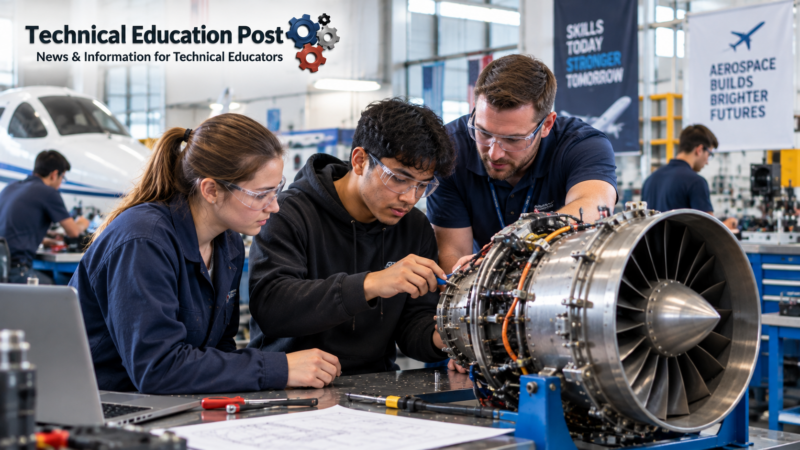
Arizona has officially opened a $6.4 million aerospace and defense workforce training center in Mesa, bringing together community colleges, state economic development officials, and major industry employers to strengthen the state’s advanced manufacturing workforce.
The Aerospace & Defense Future48 Workforce Accelerator, located at Chandler-Gilbert Community College’s Williams Campus, is expected to serve nearly 1,000 students annually through specialized technical education and hands-on training.
The 14,058-square-foot facility includes classrooms, laboratories, and practical training spaces designed to prepare students for aerospace manufacturing occupations, with an emphasis on composites, structural fabrication, and mechanical assembly.
Governor Katie Hobbs joined representatives from Maricopa Community Colleges, the Arizona Commerce Authority, and aerospace industry partners for the October 6, 2026, ribbon-cutting ceremony.
The opening represents more than another investment in technical education infrastructure. It demonstrates an increasingly important workforce development strategy: organizing training around clearly identified employer needs while using community colleges as regional centers for industrial talent development.
For career and technical education administrators, community college leaders, and manufacturing employers, the project offers a model worth examining—particularly as communities seek to expand technical training capacity without separating education from actual workforce demand.
Key Takeaways
-
Arizona invested $6.4 million through the Arizona Commerce Authority to renovate and equip the training facility.
-
The 14,058-square-foot accelerator is designed to serve nearly 1,000 learners annually.
-
Instruction builds on existing composites and sheet metal training, with additional courses and certificates under development.
-
An industry advisory board involving 16 employer partners helps guide curriculum development.
-
The facility is part of a broader $30 million Future48 initiative supporting workforce training in advanced manufacturing and strategic industries.
What Happened: Arizona Opens a Dedicated Aerospace Training Facility
The new accelerator was established through a partnership involving Chandler-Gilbert Community College (CGCC), Maricopa Community Colleges, and the Arizona Commerce Authority.
Its development followed a February 2025 announcement identifying CGCC as the site of an aerospace-focused Future48 facility.
After renovation and development, the training center officially opened in October 2026.
FACILITY AT A GLANCE
$6.4M
State investment
14,058
Square feet
~1,000
Planned annual learners
16
Industry advisory partners
Figures reported by Maricopa Community Colleges and the Arizona Commerce Authority. Annual learner capacity is a projection, not a reported completion total.
The facility expands CGCC’s existing aviation and aerospace-related instruction while creating dedicated capacity for industry-oriented skills development.
Its labs and training areas are intended to replicate relevant aspects of industrial work, allowing students to develop experience with equipment, materials, and processes used in aerospace manufacturing.
Industry Partners Help Shape the Training
One of the initiative’s most consequential features is its employer involvement.
The October opening included representatives from aerospace and technology companies such as Boeing, Honeywell Aerospace, Gulfstream Aerospace, Garmin, Able Aerospace, and other regional partners.
CGCC has also established a Business & Industry Advisory Leadership Team (BILT) Advisory Board comprising college leaders and 16 industry partners.
Rather than relying exclusively on conventional academic curriculum-development cycles, the advisory structure gives employers a continuing role in identifying occupational skills and emerging training requirements.
The college reports that it is working with industry partners to develop additional skills-based classes and certificates, including precision measurement and avionics.
These areas are particularly relevant to aerospace operations, where manufacturing accuracy, quality verification, and technical system knowledge are essential.
The advisory arrangement may offer a replicable model for institutions seeking to maintain industry relevance as technology changes.
Why the Aerospace Workforce Accelerator Matters
Aerospace manufacturing presents technical education institutions with a distinctive instructional challenge.
Production involves specialized materials, complex components, rigorous documentation, and demanding quality requirements.
Workers must be able to apply technical knowledge consistently while operating in environments where errors can have significant safety and financial consequences.
The Mesa facility addresses several important aspects of this challenge.
1. Connecting Instruction to Industry Competencies
Traditional degree programs often provide broad technical foundations.
Employer-aligned workforce programs can complement those foundations by organizing instruction around specific processes, technologies, and occupational competencies.
At CGCC, existing composites and sheet metal instruction provides a starting point for expanded aerospace-related training.
Additional instruction in precision measurement and avionics could broaden pathways into manufacturing, inspection, and technical support occupations.
2. Increasing Access to Hands-On Training
Advanced manufacturing education requires more than lectures and computer-based instruction.
Students need opportunities to work with materials, instruments, and equipment under appropriate supervision.
Purpose-built facilities can improve this access by providing laboratory environments designed around occupational skill development.
However, their effectiveness depends on qualified instructors, properly maintained equipment, and sufficient time for practical exercises.
3. Strengthening Local Education-to-Employment Pathways
Regional workforce partnerships can shorten the organizational distance between educational institutions and employers.
When companies help define competencies, colleges gain information that may improve course planning.
Employers, in turn, gain opportunities to engage with prospective workers before recruitment.
For students, these relationships can help make education-to-employment pathways more visible.
The model does not automatically guarantee jobs, but it establishes a stronger framework for coordinating training and hiring needs.
Broader Industry Trends: The Rise of Regional Workforce Accelerators
Arizona’s new aerospace facility is part of a larger workforce strategy.
The Arizona Commerce Authority’s Future48 initiative includes six workforce accelerators supported by approximately $30 million in state investment.
These facilities focus on industries such as semiconductors, advanced manufacturing, battery manufacturing, and aerospace and defense.
They are located across several Arizona communities, including Mesa, Phoenix, Apache Junction, Casa Grande, Kingman, and Tucson.
The strategy reflects a transition toward industry-centered training ecosystems.
Instead of expecting every educational institution to provide extensive facilities for every industrial specialization, states can concentrate selected resources where employer demand, institutional capabilities, and regional economic priorities intersect.
This approach can offer advantages in equipment utilization and employer engagement.
It also creates important governance questions.
Institutions must determine how to balance immediate employer demands with longer-term educational objectives, including students’ ability to transfer skills across industries.
An effective accelerator should prepare workers for current jobs without leaving them dependent on a narrow set of technologies or employers.
Expert Perspectives: Government, Education, and Industry
Maricopa Community Colleges Chancellor Dr. Steven Bloomberg emphasized the educational value of environments that resemble actual workplaces.
“By learning in spaces that mimic real-world environments, our students become fluent in the areas and skills that our business and industry partners are seeking.”
The statement reflects a central design principle of the accelerator: technical education should provide students with opportunities to practice occupational competencies in realistic environments.
CGCC President Dr. CJ Wurster likewise emphasized the role of faculty and employer collaboration in developing relevant curriculum.
From the state’s perspective, the investment supports economic development by increasing the availability of trained workers for strategically important industries.
These are perspectives from participating organizations. Independent evidence about enrollment, employment, and program effectiveness will be needed to evaluate the facility’s longer-term performance.
Practical Takeaways for CTE and Community College Leaders
The Mesa project offers several lessons for institutions considering similar investments.
Begin with occupational competencies, not equipment purchases. Identify what employers expect workers to know and demonstrate before determining the technology and facilities required.
Create an active employer advisory process. Advisory boards should contribute to curriculum, learning outcomes, and program evaluation rather than functioning only as occasional networking groups.
Invest in instructor development. New equipment has limited educational value without instructors who understand its applications and can design meaningful learning experiences.
Build transferable competencies into specialized programs. Precision measurement, technical documentation, material science, quality assurance, and problem-solving can serve students across multiple industries.
Establish outcome measures before opening. Institutions should define how they will evaluate recruitment, completion, skills attainment, employment placement, and employer satisfaction.
Questions to Ask Your Program
-
Are regional employers involved in defining our program’s technical competencies?
-
Does our equipment reflect the processes students will encounter in employment?
-
Do faculty members receive regular opportunities for industry professional development?
-
Are our certificate and degree pathways aligned with clear occupational outcomes?
-
Can students use the competencies they acquire across multiple employers or industries?
-
Do we track program effectiveness beyond enrollment and graduation?
Future Outlook: What Happens After the Grand Opening?
The next phase will be implementing training programs and evaluating whether the facility reaches its expected capacity.
CGCC’s development of additional classes and certificates in precision measurement and avionics will be an important area to monitor.
Other significant indicators include employer participation, the number of students completing training, and the proportion entering relevant employment or continuing their education.
Because the accelerator has only recently opened, these outcomes cannot yet be established.
For policymakers considering similar investments, the most meaningful evidence will emerge over several years rather than from initial facility announcements.
Frequently Asked Questions
What is the Future48 Aerospace & Defense Workforce Accelerator?
It is a workforce training facility at Chandler-Gilbert Community College designed to prepare students for aerospace, defense, and related advanced manufacturing careers.
Where is the facility located?
It is located at CGCC’s Williams Campus in Mesa, Arizona.
How much did it cost?
The Arizona Commerce Authority invested $6.4 million in the renovated facility.
How large is the training center?
The facility covers 14,058 square feet.
How many students will it train?
It is expected to serve nearly 1,000 learners annually. This is a planned capacity figure.
What skills will students learn?
The accelerator builds on composites and sheet metal training, emphasizing skills associated with aerospace structures and mechanical assembly. Additional classes and certificates in precision measurement and avionics are being developed.
Which employers are involved?
Industry participants include Boeing, Honeywell Aerospace, Gulfstream Aerospace, Garmin, Able Aerospace, and other regional companies. The advisory board includes 16 industry partners.
Can other states replicate this model?
Potentially. The transferable elements include employer-informed curriculum, community college partnerships, investment in practical laboratories, and measurable workforce development goals. Outcomes will depend on regional industries and institutional resources.
TechEd Magazine Perspective
Arizona’s Aerospace & Defense Future48 Workforce Accelerator illustrates how technical education is becoming more closely integrated with regional economic development.
The facility’s significance extends beyond its $6.4 million investment and projected annual training capacity.
Its most important feature is the structured collaboration among educators, employers, and economic development agencies.
If that collaboration produces relevant curriculum, meaningful technical competencies, and measurable employment outcomes, the accelerator could offer a useful model for workforce programs elsewhere.
For CTE directors and community college administrators, the essential lesson is that workforce facilities should not be evaluated only by their size, cost, or equipment.
Their ultimate value depends on what students learn, which opportunities become available to them, and how effectively those outcomes meet the needs of both workers and industry.