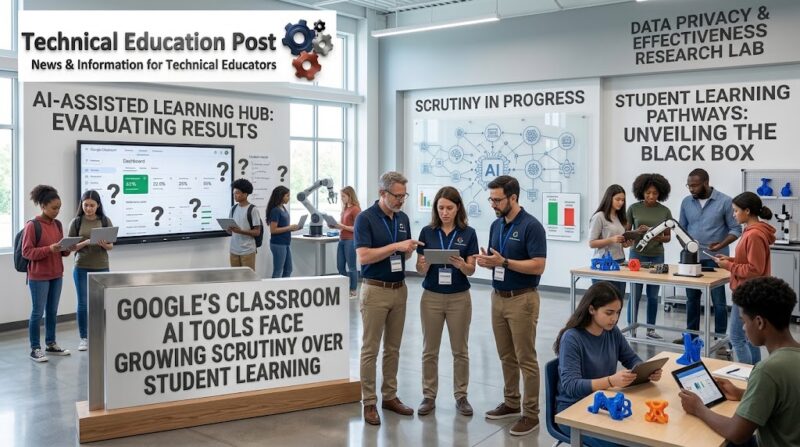
Educators and lawmakers are questioning whether artificial intelligence tools embedded in classroom technology are supporting students—or replacing essential learning experiences.
The expanding presence of artificial intelligence in American classrooms is generating new questions about student learning, academic independence, and the responsibilities of educational technology providers.
Connecticut educators and U.S. Senator Richard Blumenthal have raised concerns about Google’s integration of artificial intelligence into products commonly used by schools.
According to October 28 reporting by CT Insider, the concerns include students relying on AI to complete assignments, limited control over embedded AI features, and the potential effects on critical thinking and independent learning.
The debate presents an important challenge for technical educators: How can schools prepare students to use increasingly powerful AI tools without allowing those tools to replace the knowledge and skills students are expected to develop?
AI Is Becoming Part of Everyday Classroom Technology
Artificial intelligence is no longer confined to specialized educational software.
AI-assisted features are increasingly integrated into search engines, web browsers, productivity applications, and digital learning platforms.
Google’s widespread presence in education means these developments can affect classrooms where students use Chromebooks, Google Classroom, and other connected services.
AI tools can help users generate explanations, summarize information, draft documents, and solve problems.
These capabilities may provide educational benefits when used appropriately.
For example, students might use AI to obtain additional explanations of difficult concepts, explore alternative approaches to a problem, or receive feedback on their work.
However, the same technologies may also produce completed assignments with relatively little independent student effort.
That distinction is central to the growing debate.
Connecticut Educators Raise Concerns
At a Hartford press conference reported October 28, Blumenthal and Connecticut Education Association President Kate Dias criticized aspects of Google’s AI integration in educational products.
Their concerns included the difficulty of disabling certain embedded AI features and the possibility that students may become excessively dependent on automated assistance.
Educators also raised questions about the consequences of allowing AI to perform tasks that are intended to develop writing, research, mathematical reasoning, and other foundational abilities.
The issue is not simply whether AI-generated answers are accurate.
Students may receive correct answers without understanding the underlying concepts.
When assignments are completed without meaningful effort, educators may struggle to determine what students have actually learned.
Some Connecticut school districts are reportedly reconsidering their classroom technology practices, including returning certain assignments to paper-based formats.
Lawmakers Seek Answers From Google
The October 28 discussion follows an October 21 letter from Senators Richard Blumenthal and Josh Hawley to Google CEO Sundar Pichai.
The senators requested information about Google’s promotion of AI tools in schools and the company’s understanding of their potential effects on students.
Their questions addressed several issues, including:
- Research into the educational and psychological effects of AI tools
- Default AI integration in educational products
- Options available to schools seeking to limit AI features
- Complaints or concerns raised by educators and families
- Resources provided to schools adopting AI technology
- Measures intended to protect younger users
The senators requested a response by November 2, 2026.
The inquiry raises questions about the appropriate balance between technology innovation, institutional control, and student protection.
Google maintains that its education products are developed with attention to privacy, compliance, and educational needs.
The debate therefore involves both the potential benefits of AI-assisted learning and concerns about how those tools are deployed and controlled.
Why the Debate Matters for Technical Education
Career and technical education presents a particularly important setting for evaluating AI use.
Students in programs such as welding, automotive technology, industrial maintenance, machining, electronics, and healthcare must demonstrate practical competencies.
AI can explain how a system operates, identify possible troubleshooting procedures, or help students understand technical terminology.
However, these capabilities cannot replace the practical experience required to perform many occupational tasks safely and effectively.
A student studying electrical systems, for example, may use AI to review circuit concepts.
But the student still needs to develop the ability to interpret diagrams, use test instruments, follow safety procedures, and diagnose actual equipment.
Similarly, a machining student may use AI to explore programming concepts while still needing to understand measurements, tooling, machine setup, and safe operating practices.
The educational objective should be to develop technical judgment, not simply produce answers.
Using AI Without Sacrificing Fundamental Skills
Educational institutions can consider several strategies for balancing AI adoption with independent learning.
Establish clear expectations. Students should understand when AI assistance is permitted and when assignments must demonstrate independent work.
Emphasize practical assessment. Hands-on demonstrations, laboratory activities, and observed performance can help instructors evaluate actual competencies.
Teach AI verification. Students should learn to question AI-generated information and compare it with trustworthy technical references.
Protect foundational learning. Mathematics, reading, writing, mechanical reasoning, and problem-solving should remain central to instruction.
Train educators. Teachers need opportunities to understand AI capabilities, limitations, and appropriate applications.
These approaches may help students develop AI literacy while preserving the educational value of direct practice.
AI Literacy Is Becoming a Workforce Skill
Although concerns about overreliance are legitimate subjects for investigation, avoiding AI entirely may also create challenges.
Employers are beginning to incorporate AI into technical documentation, information retrieval, software development, administrative tasks, and other workplace processes.
Students entering these environments may benefit from understanding how to use AI responsibly.
Technical education programs therefore face two related responsibilities.
They must prepare students to work with emerging technologies while ensuring that graduates possess the underlying skills necessary to evaluate and act on AI-generated information.
An employee who can operate an AI tool but cannot recognize an incorrect technical recommendation may introduce serious operational risks.
The ability to verify results and apply professional judgment remains essential.
Developing Effective School AI Policies
School leaders should consider developing policies that address both educational and practical concerns.
Such policies may define approved uses, establish transparency expectations, address data privacy, and clarify how instructors assess student understanding.
Technology administrators should also evaluate the settings and controls available within software purchased or deployed by their institutions.
For technical programs, AI policies may need to distinguish between low-risk instructional assistance and activities involving safety-critical operations or professional certification.
The goal should not be to eliminate every technological shortcut.
Instead, policies should ensure that technology supports the intended learning outcomes.
The Future of AI in Career and Technical Education
The debate surrounding Google’s classroom AI products reflects a larger transition in education.
Artificial intelligence offers opportunities to support instruction, improve access to information, and introduce students to tools they may encounter in their careers.
At the same time, educators must protect the development of independent thinking, technical competence, and responsible decision-making.
These objectives are not necessarily incompatible.
Thoughtful AI implementation can provide students with new learning resources while maintaining clear expectations for mastery.
For career and technical education, the most effective approach may be one that treats AI as a support tool rather than a substitute for instruction, practice, and human judgment.
Sources:
CT Insider, October 28, 2026:
https://www.ctinsider.com/news/education/article/blumenthal-ct-teachers-google-ai-schools-22496607.php
Official U.S. Senate announcement, October 21, 2026:
https://www.blumenthal.senate.gov/newsroom/press/release/blumenthal-and-hawley-demand-answers-from-google-about-aggressive-ai-push-in-classrooms