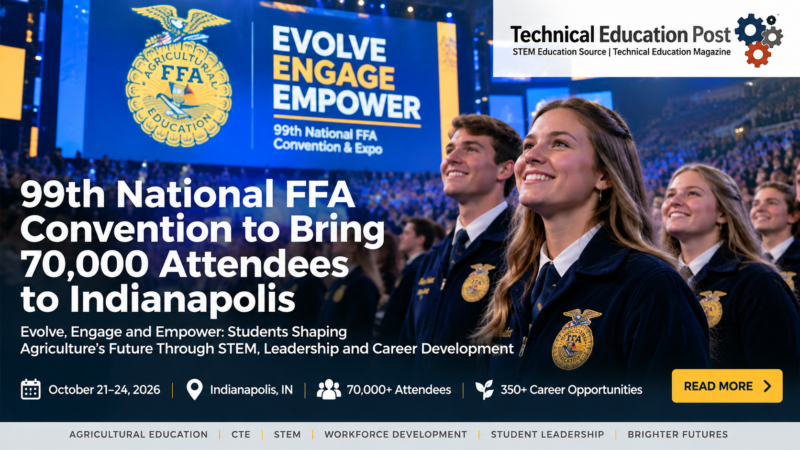
More than 70,000 students, educators, and agricultural industry supporters are expected to gather in Indianapolis October 21–24 for the 99th National FFA Convention & Expo, one of the nation’s largest celebrations of career and technical education, student leadership, and agricultural workforce development.
INDIANAPOLIS — The National FFA Organization is preparing to welcome thousands of young agricultural leaders to Indianapolis for four days of hands-on learning, career exploration, competitions, and recognition of student achievement.
Under the theme “Evolve, Engage and Empower,” the 99th National FFA Convention & Expo will take place October 21–24, 2026, across several Indianapolis venues, including the Indiana Convention Center, Lucas Oil Stadium, Gainbridge Fieldhouse, and the Indiana State Fairgrounds.
The convention reflects the expanding role of agricultural education in preparing students for careers that increasingly combine traditional agricultural knowledge with advanced technology, engineering, environmental science, and business management.
With more than 1.05 million student members representing 9,591 local chapters across all 50 states, Puerto Rico, and the U.S. Virgin Islands, National FFA has become a significant force in American career and technical education.
Agricultural Education Expands Beyond Traditional Farming
While agriculture remains central to FFA’s mission, today’s agricultural education programs encompass a diverse range of scientific and technical disciplines.
Students can explore career pathways involving biotechnology, food science, agricultural engineering, natural resources, environmental management, equipment systems, and agribusiness.
National FFA identifies more than 350 career opportunities across the agricultural industry, highlighting the breadth of modern agricultural employment.
For career and technical education instructors, these fields represent opportunities to integrate agricultural education with broader STEM coursework and work-based learning experiences.
For example, agricultural engineering and equipment systems can introduce students to mechanical design, automation, and technical maintenance. Environmental and plant science programs provide opportunities to apply biology, chemistry, and data analysis to real-world production challenges.
These connections are particularly valuable as schools seek to demonstrate how academic subjects translate into practical career opportunities.
Students Demonstrate Skills Through Research and Hands-On Experiences
The convention’s Student Showcase stage will highlight research and projects developed by FFA members and local chapters.
Presentations will include agriscience fair research and Supervised Agricultural Experiences (SAEs), a foundational component of agricultural education that allows students to apply classroom knowledge through projects, employment, entrepreneurship, and other supervised activities.
These experiences reinforce the importance of learning by doing.
Instead of relying exclusively on classroom instruction, students develop technical competencies while solving practical problems, conducting investigations, managing projects, and communicating their findings.
The convention will also provide opportunities for students to participate in competitive events, attend educational workshops, and interact with peers from rural, suburban, and urban communities.
“What makes this convention special is that our members don’t just receive recognition – they engage with one another and empower each other,” said Christine White, chief program officer of the National FFA Organization.
“Whether they’re presenting research on the Student Showcase stage, serving alongside one another in the community or earning their American FFA Degree, they leave Indianapolis ready to lead back home.”
Career Exploration Connects Students With Agricultural Industries
One of the convention’s most important components for technical education is the National FFA Expo.
Through exhibits, educational activities, and industry connections, participating students will have opportunities to learn about more than 350 agricultural careers.
The event also includes Career Success Tours designed to introduce students to actual workplaces and professional environments.
The tours cover eight agricultural career areas, including biotechnology systems, environmental service systems, food processing, natural resources, and power, structural, and technical systems.
These activities can help students connect their educational interests with occupations they may not have previously considered.
For employers, the convention offers an opportunity to engage with emerging talent and promote careers that require specialized technical skills.
For educators, the event reinforces the value of connecting classroom instruction with industry expectations and workforce opportunities.
Recognizing Student Achievement and Leadership
The 99th National FFA Convention will recognize thousands of individuals for accomplishments in agricultural education and leadership development.
According to the organization’s October 8 announcement:
- 5,816 American FFA Degrees are scheduled to be awarded to members demonstrating outstanding achievement.
- 236 Honorary American FFA Degrees will recognize individuals who have made significant contributions to FFA and agricultural education.
- Students will compete in a range of events demonstrating technical knowledge, leadership, communication, and career-related competencies.
- Individual members and chapters will receive recognition for achievements and service.
The American FFA Degree is among the organization’s highest honors, reflecting sustained involvement, achievement, and leadership.
Recognition programs help demonstrate how structured career and technical education can develop both occupation-specific competencies and transferable skills.
Professional Development Opportunities for Teachers and School Leaders
The convention is not solely a student event.
Agricultural educators, school administrators, counselors, and CTE directors will also have opportunities to participate in workshops and professional learning activities.
The School Leaders’ Summit will provide a closer look at the educational value of agricultural education and FFA programming.
Superintendents, principals, counselors, and career and technical education directors are invited to participate in specialized sessions and behind-the-scenes convention tours.
These activities create opportunities for school leaders to examine how agricultural education supports career exploration, student engagement, and leadership development.
The convention will also feature keynote presentations by Scott McKain and Reagan Pugh, along with general sessions and workshops for students and educators.
Community Service Remains Central to the FFA Experience
Leadership development at the convention extends beyond competitions and awards.
Approximately 3,240 delegates and students are expected to participate in community service activities benefiting 27 nonprofit organizations in the greater Indianapolis area.
The projects reflect the FFA tradition of combining leadership development with community engagement.
Through service, students have opportunities to practice teamwork, responsibility, communication, and project coordination—skills that are also relevant to workplace success.
The convention’s Chapter Connect program will further encourage interaction among FFA members from different geographic and educational backgrounds.
Convention Expected to Generate $40 Million in Economic Activity
Beyond its educational significance, the National FFA Convention & Expo is an important annual event for Indianapolis.
Organizers estimate that the 2026 gathering will generate approximately $40 million in economic activity for the city.
More than 100 hotels are expected to accommodate attendees during convention week.
Last year’s convention attracted a record crowd of more than 73,000 participants, demonstrating the scale of the organization’s national membership and educational programming.
National FFA has also secured Indianapolis as the convention’s host city through at least 2040, providing long-term continuity for the annual event.
Bringing the Convention Into Classrooms Nationwide
Schools and FFA chapters unable to travel to Indianapolis will still be able to participate virtually through FFA Live!, the organization’s online convention broadcast.
The streaming program will include general sessions, student presentations, competition coverage, interviews, and other convention activities.
For agricultural education instructors, the broadcasts offer an opportunity to expose students to national career development experiences without requiring travel.
Teachers can also incorporate selected convention content into lessons about agricultural careers, technical skills, leadership, and student achievement.
The 99th National FFA Convention & Expo will begin Wednesday, October 21, with the Expo Hall opening at 9 a.m. Eastern Time. Activities conclude Saturday, October 24, with the election of the new National FFA Officer Team.
Additional information, event schedules, and streaming details are available at https://convention.ffa.org/.
Why the National FFA Convention Matters for Technical Education
As American education continues to emphasize career readiness, work-based learning, and industry-aligned instruction, agricultural education offers an established model for integrating classroom learning with practical experience.
The National FFA Convention demonstrates how students can develop scientific knowledge, technical abilities, leadership skills, and professional connections through a coordinated educational framework.
For CTE administrators and instructors, the event also illustrates the importance of making career pathways visible to students long before they enter the workforce.
Whether students pursue agricultural engineering, biotechnology, skilled trades, environmental science, food production, or business management, the broader lesson is consistent: meaningful technical education connects knowledge with application.