
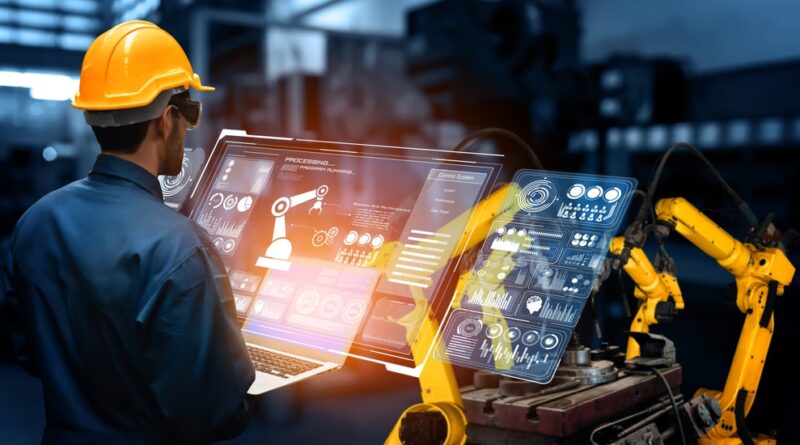
The State of AI in Manufacturing
Over the past few years, artificial intelligence has woven its way into our everyday lives. However, beyond consumers, the same has happened to large manufacturing operations around the globe. From predictive maintenance to automated quality control, AI algorithms and machine learning have been enhancing efficiency, safety, and productivity on factory floors. That said, the road to widespread adoption still faces challenges, and manufacturing companies must think long and hard about how to implement AI in ways that deliver long-term value. The State of AI in Manufacturing.
A Brief History of AI in Manufacturing
The use of AI in manufacturing processes has its roots in early automation and robotics. In the 1980s and 1990s, manufacturers began using computer-aided design (CAD), robotics, and early machine learning tools to improve productivity and operational efficiency. This era also saw the rise of lean manufacturing and Six Sigma—both of which aim to optimize manufacturing processes by using data-driven decision-making and continuous improvement.
In the 2000s and 2010s, the emergence of the Industrial Internet of Things (IIoT), as well as cloud computing and advanced sensors, made companies within the manufacturing sector more able to collect and analyze data at scale. These technologies set the stage for what is now called Industry 4.0, where artificial intelligence and machine learning aid in making smarter, more adaptive factories.
While traditional industrial robots replaced human labor for repetitive tasks, AI-powered systems now complement them. Today, manufacturers use robots not only as replacements for human workers but also alongside AI algorithms that can analyze data in real time, optimize assembly processes, and even anticipate equipment failures before they occur.

The Benefits of Artificial Intelligence in the Manufacturing Industry
One of the most immediate benefits of using AI models in manufacturing is predictive maintenance. AI models can analyze machine performance data, identify patterns, and forecast when equipment is likely to fail. This allows manufacturers to protect their valuable physical assets and avoid costly downtime, delivering both operational resilience and significant cost savings.
Another major advantage is improved quality assurance. Computer vision systems powered by AI and deep learning can inspect thousands of products per minute. They can even spot microscopic defects with far greater accuracy than human eyes. AI also helps manufacturers improve supply chain management, providing better forecasting and inventory control so they can anticipate future demand more accurately. Beyond efficiency, though, artificial intelligence can contribute to worker safety by monitoring factory conditions and assisting employees through collaborative robots.

Advancements in AI Technologies for Manufacturing
The last decade has seen a rapid evolution in the technologies available to the manufacturing industry. Generative AI, once used mainly for text and image creation, is now beginning to be applied to engineering and design. It uses algorithms to generate optimized component geometries or production workflows.
Digital twins, which allow manufacturing operations to simulate and test what-if scenarios before making the actual changes on the factory floor, have also advanced significantly. They’ve moved from simple 3D models to high-fidelity, data-driven replicas that integrate real-time IIoT sensor data and cloud analytics.
Another major development in AI solutions is the growth of edge AI, which enables real-time monitoring and optimization of assembly processes, improving both speed and precision. Through several improvements in semiconductor design and embedded processing power, data can be processed directly on the machine rather than relying solely on cloud systems. This type of smart manufacturing allows for faster, real-time decision-making in areas like quality inspection and robotic control.
Additionally, agentic AI is emerging (albeit largely experimental at present), signaling a shift from static, task-based algorithms toward more autonomous systems that are capable of limited reasoning and adaptive behavior within complex environments. AI can assist with routine tasks, allowing human workers to focus on more complex decision-making and problem-solving. But AI is more than a way of completing mundane and repetitive tasks; it’s starting to have the ability to make decisions that keep manufacturing processes running smoothly.

The Current State of AI Adoption
It’s quite clear that artificial intelligence has incredible potential. But despite this, adoption rates remain uneven. According to industry surveys, investment in AI within manufacturing is increasing steadily. Yet, many organizations are choosing to stay in experimental phases rather than fully adopt the technology.
Larger manufacturers with deeper resources tend to be early adopters of generative AI and other advanced AI applications. Many of them are rolling out AI across the entire supply chain and on the shop floor. Smaller firms, though, often face barriers related to cost, expertise, or infrastructure. The result is a fragmented adoption process, where pilot projects seem extremely promising, but broad transformation has yet to occur. Reports suggest that while executives recognize the transformative potential of AI, many admit that they lack a full understanding of more advanced systems such as agentic AI.
Studies also mention the so-called “productivity paradox,” in which investment in AI tools does not immediately translate into measurable efficiency gains. Research from MIT Sloan highlights that many manufacturers are still in pilot phases, and scaling these technologies across entire organizations remains a bit of an issue. Much of this is because moving over to AI requires systemic change, and is not a matter of “plug and play.”
It’s estimated that adoption in manufacturing is rising steadily, but is somewhat concentrated in a handful of use cases. Global initiatives like the World Economic Forum’s Lighthouse Network also point to the gap between leading companies scaling AI successfully and those lagging behind.

The Challenges of AI and Machine Learning in Manufacturing
Despite the ongoing shift toward smart factories and the fact that many manufacturers are already using artificial intelligence for tasks like production planning, process optimization, and even sourcing raw materials, there are still obstacles that hinder its widespread adoption.
Firstly, although AI solutions could result in a cost reduction later on, implementation is still expensive. That’s because companies need to invest in both new technologies and the skilled workers needed to manage them. Another big issue is data quality. Fragmented or incomplete data sets make it difficult to build effective AI models. Many factories also rely on legacy systems that are not easily compatible with modern AI models, which creates integration issues.
In addition, the existing workforce needs to be trained to work effectively alongside these AI technologies. And finally, the constant rise of connected devices introduces major cybersecurity risks. Manufacturing companies will need to take a more proactive stance on digital security—something that is not only costly but also complex. Cyber threats evolve quickly and require constant vigilance.

What Manufacturing Companies Need for Long-Term Success
For manufacturing companies to truly benefit from artificial intelligence in the long term, they’ll naturally need to treat adoption as a long-term strategic initiative rather than a series of short-term experiments. Most of this boils down to the data itself. AI not only helps to process data, but it relies on it, too. If manufacturing companies build a robust data infrastructure, they’re in a much better position to adopt artificial intelligence.
At the same time, employees need to be trained on AI capabilities as soon as possible. Not just on how to use these AI solutions but also how to collaborate with and work alongside them. Companies that wish to incorporate AI into their manufacturing processes also need to design pilot projects with scalability in mind. That way, if the projects are successful, they can expand across facilities.
Businesses can also partner up with technology providers. This can help reduce implementation costs and close the gap in expertise. Most importantly, companies should approach manufacturing AI with a focus on solving specific business challenges and generating measurable outcomes rather than pursuing technology for its own sake.

The State of AI in Manufacturing—Conclusion
Artificial intelligence is no longer a futuristic concept, but is a core component of modern manufacturing. It’s an active driver of change in the manufacturing sector. It continues to help streamline manufacturing processes. Carry out predictive maintenance and quality control. And identify patterns within each machining process that can be automated. There are valid reasons as to why companies haven’t completely shifted over to tools like generative AI. It still has plenty of potential. Those who thoughtfully embrace AI in manufacturing will be best positioned to thrive in the coming years.
Featured image credit: Summit Art Creations/Shutterstock
Sources: The State of AI in Manufacturing
- https://www.ey.com/en_us/newsroom/2025/07/ai-investments-surge-but-agentic-ai-understanding-and-adoption-lag-behind
- https://mitsloan.mit.edu/ideas-made-to-matter/productivity-paradox-ai-adoption-manufacturing-firms
- https://aws.amazon.com/blogs/industries/generative-ai-applications-in-automotive-and-manufacturing/
- https://www.ien.com/redzone/blog/22945954/data-utilization-key-to-ai-adoption-sustainability-and-growth”
The State of AI in Manufacturing
https://www.thomasnet.com/insights/the-state-of-ai-in-manufacturing/
https://www.techedmagazine.com/category/news-by-industry/manufacturing-education/