
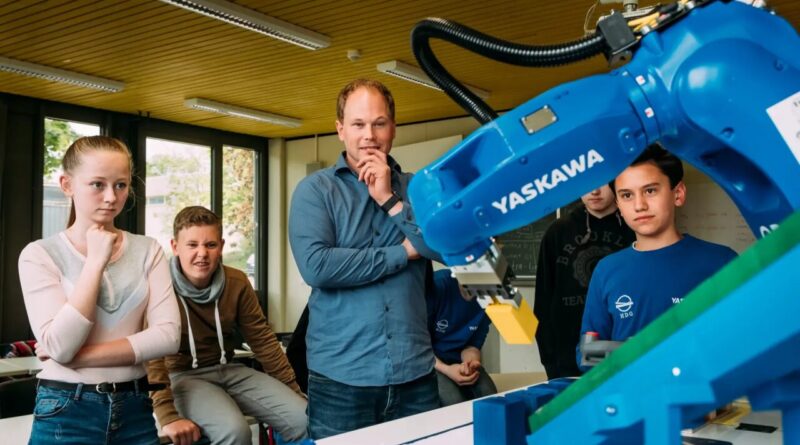
Robots and Shop Class
You can still smell it if you close your eyes: sawdust, hot solder, the faint tang of cutting oil. For most of the 20th century, American high schools had rooms where kids learned how to wire a switch, square a board, rebuild a carburetor. Then, almost quietly, those rooms vanished—replaced by test-prep labs, college-readiness seminars, and, later, rows of Chromebooks. Now, as robots slip into warehouses, hospitals, construction sites, even airports, we’re rediscovering that the future still runs on people who can read a wiring diagram and a risk assessment—who can think in both code and metal. Robots and Shop Class.
This is the story of how we lost that capacity, why it matters now, and how a new “robotics shop class” could change the country’s talent pipeline.

From “A Nation at Risk” to a nation low on wrenches
The inflection point is familiar: in 1983, A Nation at Riskwarned that American schools faced “a rising tide of mediocrity,” catalyzing an era of standards-driven reform that prioritized academic coursework and testing. Career and technical education—shop—was deemed non-core and steadily sidelined.
Two decades later, the No Child Left Behind Acttied school accountability even more tightly to reading and math scores. Districts, under pressure, expanded tested subjects and often trimmed elective, hands-on classes to make room. Research examining NCLB’s ripple effects noted how CTE courses—primarily electives—were harder to protect in this environment.
The cultural baggage didn’t help. For years, “voc ed” tracked some students—too often low-income and students of color—away from college. That stigma lingers even as modern CTE evolves. National reporting and commentary from the 2010s captured both the shrinkage of traditional shop programs and the need to rebuild themfor today’s economy.

Meanwhile, the world went robotic
While schools chased test scores, industry retooled. Robotics became normal—not sci-fi. Manufacturers adopted collaborative arms, AGVs and AMRs rolled through logistics hubs, hospitals added autonomous cleaning fleets, and construction began experimenting with layout, welding, and finishing robots. Employers say their main constraint isn’t ideas—it’s people.
Multiple studies project millions of advanced manufacturing roles could remain unfilled without a broader talent pipeline. A widely cited Deloitte–Manufacturing Institute analysis forecasts up to 2.1 million unfilled U.S. manufacturing jobs by 2030 if trends persist; more recent work emphasizes that the gap is both skills and applicants.
These aren’t all PhD roles. Many are technician jobs that blend mechanical and electrical troubleshooting, PLCs, and safety protocols—exactly the hybrid literacy that shop once cultivated. The Bureau of Labor Statisticsdescribes electro-mechanical/mechatronics technologists and technicians as the people who install, test, and maintain robotic and electromechanical systems—typically trained via community college or postsecondary certificates.

The “new shop class” already exists—just not everywhere
If you want to see what a modern shop can be, walk into a FIRST Robotics regional or a high school makerspace. FIRST reports more than 785,000 youth participants globallyin the 2023–24 season, learning to design, wire, code, and iterate under deadline—an authentic apprenticeship in systems thinking.
Alongside competitions, the maker movement put fabrication tools in students’ hands. The Fab Lab network that grew from MIT now counts thousands of spaces worldwide; the point isn’t gadgets, it’s mindset—students who learn by building real things with real constraints. MIT News
And industry is stepping in. FANUC’s Certified Education Training (CERT) program says it now partners with 1,600+ schools across the Americas to deliver robot and CNC curricula aligned to factory equipment. Siemens’ Mechatronic Systems Certification Program gives high schools and colleges a stackable path from “assistant” up through advanced mechatronics credentials.
Even employers are rebuilding shop at scale. Amazon’s Mechatronics & Robotics Apprenticeshipcombines a concentrated technical boot camp with a year of paid on-the-job learning for Reliability & Maintenance Engineering roles—an explicit “learn-and-earn” onramp into robotics maintenance.
States and universities are following suit. In August 2025, the University of Maine opened the B.O.T. Loft, a 3,600-square-foot training space inside its Advanced Manufacturing Center, with equipment from Doosan, UR, ABB, and FANUC. Doosan simultaneously launched an Authorized Training Centerthere—expanding a network that offers factory-aligned curricula from K-12 camps to professional certifications.
And because learners and employers need a trusted map, the ARM Institute built RoboticsCareer.org, a national directory (and endorsement system) to match people with vetted technician training aligned to industry-defined skills. That work is part of Manufacturing USA, funded by the Department of Defense and Labor—evidence that workforce is now seen as infrastructure.

The paradox: Robotics needs coders and craftspeople
One reason “shop” faded is that it was often framed as the opposite of academics. Robotics blows up that binary. A student troubleshooting a cobot cell must interpret torque curves and safety categories, crimp connectors to spec, read a datasheet, and write a calibration script. That’s physics, ELA (technical documentation), statistics, and CS—plus the literal feel of a ratchet.
Empirically, CTE participation correlates with better near-term labor market outcomes; modern studiesalso show that when students attend high-quality technical programs, graduation and earnings gains are significant—especially where home schools have limited offerings.
And CTE is shedding its stigma. Some districts report high-achieving students flockingto technically rigorous programs that come with industry credentials and dual credit, reframing hands-on coursework as a fast track to opportunity.

The equity catch
The new shop class is unevenly distributed. Wealthier districts and magnet programs are more likely to boast robotics labs, while under-resourced schools still struggle to offer even basic CTE. Teacher labor markets make it harder: districts report CTE teacher positions are harder to fill than academic roles, and CTE instructors with in-demand licenses can often earn ~20% morein industry.
Federal policy has started to move. In 2018, Congress reauthorized CTE funding through Perkins V, providing roughly $1.4 billion annuallyand more flexibility for states to align programs with employer needs. But dollars alone won’t fix uneven access to gear, mentors, and work-based learning.
The solution has to be systemic: equipment, plus teacher pipelines, plus industry partnerships, plus portable credentials.

What a modern “robotics shop class” should look like
1) Start with safety and systems.Treat every lab like a small factory. Teach lockout/tagout, risk assessment, and ISO/ANSI robot safety concepts alongside wiring and kinematics. A student who learns to document hazards, set E-stops, and design a safe layout becomes instantly useful—and safer. (BLS highlights that these roles involve exposure to equipment hazards mitigated by training and procedures.)
2) Build stackable credentials that actually count.Adopt industry-recognized certifications (e.g., FANUC CERT, Siemens SMSCP) that map to local demand, so a 17-year-old can graduate with signals employers trust—and continue stacking in community college or an apprenticeship.
3) Make work-based learning the default.Treat internships, co-ops, pre-apprenticeships, and apprenticeships as integral to the curriculum. Programs like Amazon’s MRA are instructive: classroom + line-side practice + job placement. Regional employers can replicate this with local colleges and workforce boards.
4) Connect students to the national map. Use platforms like RoboticsCareer.orgto help learners (and counselors) find local training that aligns with recognized career pathways—and to help employers find talent.
5) Fund teacher pipelines like critical infrastructure.States should create “earn-and-learn” fellowships to lure industry veterans into CTE teaching, with residency models and retention bonuses. Brookings’ analysis of CTE teacher attrition underscores the need for targeted policies.
6) Measure what matters. Hold programs accountable for placements, wage gains, and safety outcomes—not just enrollment. NCES’ CTE indicators give a baseline; states can augment with industry-verified assessments and longitudinal tracking.

Why this is urgent
The U.S. is pouring public and private capital into semiconductor fabs, EV plants, shipyards, depots, and defense manufacturing. The labor market data are blunt: demand is rising faster than supply, and the shortfall is increasingly in technician roles that require hands and mind. If we don’t widen the technician pipeline, a lot of taxpayer-funded equipment will sit underutilized.
There’s also a social truth that doesn’t fit neatly into spreadsheets: students remember what they build. A teen who spends a semester bringing a stuck axis back to life, or shaving five minutes off a cell’s cycle time, develops a deep sense of agency. That is the heart of career-connected learning—and the antidote to the disengagement that has haunted post-pandemic schooling.
And for those worried that “shop” will trap students below a four-year ceiling: today’s pathways are permeable. One route starts with a high-school mechatronics credential, leads to an associate degree and an apprenticeship, and later stacks into a B.S. in engineering technology—with employers helping pay the way. Robotics isn’t a detour from higher education; it’s a bridge into it.

A glimpse of what’s possible
Consider a district that pairs a high school robotics lab with a community college mechatronics program and local employers. Students rotate through FIRST season in the fall, earn FANUC or Siemens Level 1 in the spring, and spend the summer paid—shadowing maintenance techs in a warehouse, a hospital’s facilities team, or an advanced manufacturing cell. Seniors choose: direct hire at 18, a pre-apprenticeship, or dual enrollment toward an associate. Counselors use RoboticsCareer.orgto keep the ladder visible; teachers get release time to update their own certifications. The lab looks like a small integrator: CAD, metrology, pneumatics, a vision kit, a cobot, a mobile base, safety fencing—and a clear hazard plan on the door.
States are inching this way. School systems are investing in advanced CTE facilities, and universities are launching training hubs tied to defense and industry demand—like the University of Maine’s new B.O.T. Loft, which explicitly exists to help companies trialautomation and train the humans who will run it. That’s shop class as economic strategy.
Bring back shop—on purpose
We don’t need nostalgia. We need ambition: to treat hands-on technical education as a first-class route to prosperity and national capacity. The blueprint is on the table:
- Keep the rigor of academic standards and restore the rigor of the lab.
- Fund spaces, tools, and—most importantly—teachers.
- Tie programs to real credentials, real employers, and real safety.
- Make sure every student, not just the already advantaged, can reach the onramps.
If A Nation at Riskhelped push us into an era of narrow metrics, Perkins V and employer-backed models can help bring balance—resourcing CTE to meet what the economy actually needs.
The choice is less about robots than about respect for the people who will build, integrate, fix, and improve them. The smell of sawdust might be gone, replaced by the hum of a harmonic drive. But the core of shop class—the alchemy of learning by making—still changes lives. Let’s bring it back, tuned for a robotic age.
Source: Robots and Shop Class
Robots and the Death of Shop Class: How education policy short-circuited hands-on skills—and why robotics might bring them back

Aaron Prather, Director, Robotics & Autonomous Systems Program at ASTM International