
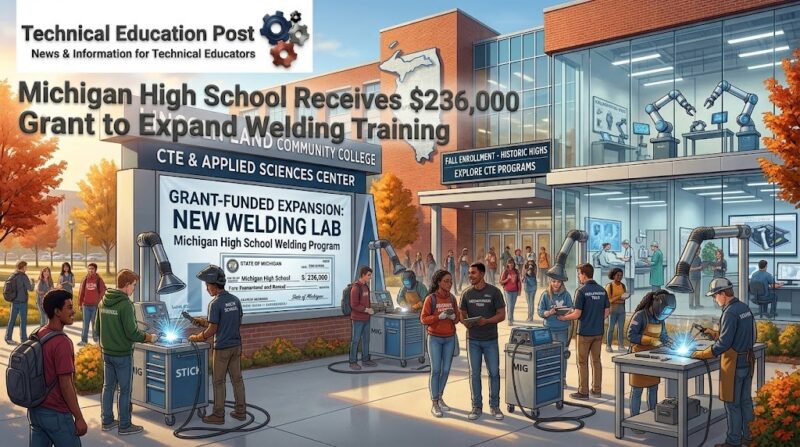
A northern Michigan school district is investing in welding equipment, expanded instructional capacity, and earlier exposure to skilled-trades careers.
A northern Michigan high school welding program is preparing for a significant expansion following the award of a $236,177 career and technical education grant.
Benzie County Central Schools received the Michigan CTE funding to support its welding and fabrication program, according to reporting published October 28 by the Benzie County Record Patriot.
The investment could increase the program’s welding capacity from six stations to 14 while supporting additional equipment, supplies, instruction, and curriculum development.
For schools seeking to strengthen skilled-trades education, the grant illustrates how targeted funding can expand hands-on learning opportunities while creating important questions about long-term program sustainability.
Expanding Welding Education Capacity
Welding education requires specialized facilities, equipment, instructional supervision, and safety procedures.
Unlike many traditional classroom subjects, welding programs must provide students with opportunities to practice technical skills using equipment similar to that found in professional workplaces.
Benzie Central’s proposed expansion would more than double the number of available welding stations.
According to the local report, instructor Dylan Lightfoot hopes to increase capacity from six stations to 14 and add a boom welder.
The additional equipment could allow more students to participate in practical instruction while improving access to different welding processes and fabrication techniques.
The investment has also prompted discussions about redesigning the school’s workshop to accommodate expanded training.
How the Grant Will Be Distributed
The $236,177 award is scheduled to be distributed over three years.
The reported funding schedule includes:
- First year: $91,987
- Second year: $73,927
- Third year: $70,263
The funding may support instructor compensation and benefits, equipment, tools, protective equipment, supplies, curriculum, and professional development.
The multi-year structure is significant because it allows the district to plan for program expansion while gradually assuming responsibility for ongoing operational costs.
Purchasing equipment is only one part of developing a sustainable technical education program.
Schools must also budget for maintenance, consumable materials, safety inspections, instructional staffing, and periodic equipment replacement.
Welding Remains an Important Skilled Trade
Welding is used across numerous industries, including manufacturing, construction, transportation, energy, equipment repair, and metal fabrication.
Students learning welding develop more than the ability to join pieces of metal.
A comprehensive welding program can introduce blueprint reading, measurement, metallurgy, fabrication planning, equipment maintenance, and workplace safety.
Technical education can also provide exposure to related occupations such as industrial maintenance, pipefitting, machining, and structural fabrication.
Industry-aligned training often incorporates multiple welding processes, including shielded metal arc welding, gas metal arc welding, and gas tungsten arc welding.
Students may eventually pursue additional credentials or specialized training depending on their career goals.
For schools, maintaining an effective welding program means balancing foundational instruction with changing industry practices.
Introducing Skilled Trades Earlier
One particularly noteworthy component of Benzie Central’s plans is the possibility of offering an introductory metal craft class for middle school students.
Early career exploration can help students discover interests and abilities before selecting high school courses or postsecondary education pathways.
Exposure to fabrication and other technical activities also provides opportunities to apply mathematics, design principles, measurement, and problem-solving.
Middle school experiences need not involve advanced welding operations to be valuable.
Age-appropriate fabrication activities, design projects, introductory tool education, and supervised demonstrations can help establish an understanding of skilled-trades occupations.
Such programs may also encourage students who do not initially consider manufacturing or technical careers.
Preserving Technical Education in Local Communities
The Benzie Central program reflects a longstanding local commitment to shop education.
According to the Record Patriot, the district’s shop-class tradition dates to 1963.
Maintaining these programs is particularly important in communities where access to specialized technical instruction may be limited.
High school CTE programs can provide career awareness, initial technical competencies, and a foundation for additional education.
They can also help local employers connect with prospective workers and participate in workforce-development partnerships.
However, a single grant cannot address every challenge facing skilled-trades education.
Recruiting qualified instructors, maintaining facilities, and ensuring continuing financial support remain important considerations.
Lessons for Other School Districts
Benzie Central’s expansion offers several lessons for districts considering similar investments.
First, instructional capacity matters. Increasing the number of available training stations can improve student access to practical learning.
Second, equipment investments should support defined learning outcomes. New machinery is most valuable when connected to an updated curriculum and qualified instruction.
Third, earlier career exploration can strengthen future enrollment. Introducing students to technical subjects before high school may help them make more informed decisions.
Finally, sustainability must be part of the plan. Districts need realistic budgets for the years following initial grant funding.
Strengthening the Skilled-Trades Pipeline
The Benzie Central investment demonstrates how a relatively focused funding initiative can create meaningful opportunities for technical education.
By expanding instructional capacity and introducing additional students to fabrication, the district is positioning its program to provide broader access to practical training.
For educators and workforce-development leaders, the larger takeaway is that skilled-trades education requires sustained investment in facilities, instructors, equipment, and student pathways.
When these elements work together, local programs can help students develop valuable skills while supporting the long-term workforce needs of their communities.
Source: Benzie County Record Patriot, October 28, 2026.