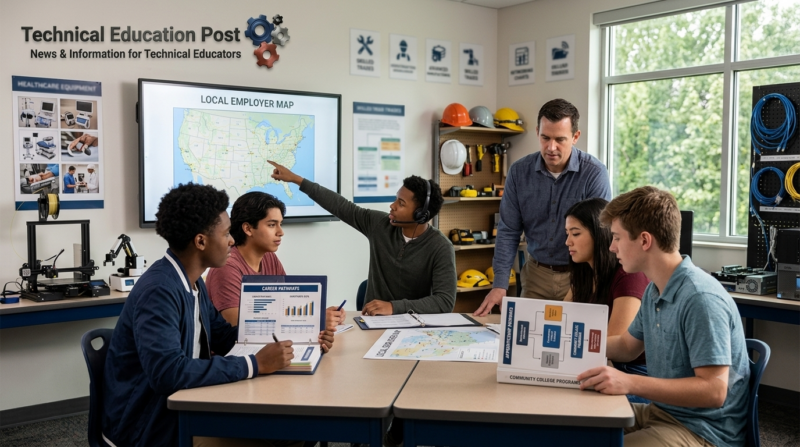
The U.S. Department of Education has launched a national competition asking high school career and technical education students to redesign how their classmates explore careers.
The Careers in Your Community Challenge, which opened August 4, 2026, invites eligible high schools to submit student-led proposals addressing gaps in career information, employer connections, postsecondary planning and access to local opportunities. Submissions are due November 19, and up to 10 winning teams will divide a $50,000 prize pool. Winners are expected to be announced in early 2027.
The prize itself is modest. The more important feature is the competition’s design.
Instead of asking consultants, software companies or administrators to determine what students need, the challenge asks CTE learners to identify where career exploration becomes confusing, incomplete or disconnected from their communities—and then propose a practical response.
That approach reflects a growing recognition that career readiness depends on more than offering a list of occupations or administering a one-time interest assessment. Students need accurate labor-market information, direct contact with employers, clear explanations of education and training pathways, sustained guidance from adults and opportunities to test their interests through real experiences.
The challenge creates a useful national experiment: What happens when students become designers of career navigation rather than passive recipients of it?
Key Takeaways
- The Careers in Your Community Challenge opened August 4, 2026, and closes November 19, 2026, at 6 p.m. Eastern Time.
- Eligible teams must represent a high school eligible for Perkins V funding and be led by a CTE teacher, coordinator or director.
- Teams can propose a digital tool, guide, event, partnership or another solution addressing career-exploration gaps.
- Submissions will be scored on career-pathway knowledge, impact, feasibility, community connection and student engagement.
- Up to 10 winning teams will divide a $50,000 prize pool.
- Research suggests that career plans alone are insufficient; adult support, regular review and real-world experiences matter.
- Schools should treat the challenge as an opportunity to improve their career-navigation systems, even if they do not win.
What the Department of Education Announced
The Careers in Your Community Challenge is the fourth competition in the Department of Education’s annual CTE Momentum series.
The 2026 competition asks high school teams to develop practical solutions that help students explore career pathways and postsecondary opportunities available in their schools and communities.
Possible solutions include:
- Increasing awareness of local employers and occupations
- Helping students understand the education, training and skills required for different careers
- Strengthening connections among students, employers, colleges and workforce organizations
- Developing a digital career-navigation tool
- Creating a student-facing guide or resource
- Organizing an event or employer-engagement program
- Establishing a new partnership or peer-support system
The department does not prescribe a specific format. Teams are encouraged to identify the approach that would have the greatest effect within their own school and community.
Challenge Details at a Glance
| Element | Requirement |
|---|---|
| Launch date | August 4, 2026 |
| Submission deadline | November 19, 2026, at 6 p.m. ET |
| Winner announcement | Early 2027 |
| Eligibility | High schools eligible to receive Perkins V funding |
| Team leader | CTE teacher, CTE coordinator or CTE director |
| Student participation | Teams may include any number of students and educators |
| Cross-disciplinary participation | Students from different grades, subjects and CTE programs may collaborate |
| Administrative approval | Principal or district-level approval is required |
| Prize pool | $50,000 divided equally among up to 10 winners |
| Selection criteria | Career-pathway knowledge, impact, feasibility, community connection and student engagement |
Schools do not currently have to receive Perkins V funding, but they must be eligible to receive it. Multiple teams from one school may enter, although only one team from a school can win. Teams may also collaborate across schools as long as one lead school and one qualifying team leader are identified.
Why Career Exploration Is a Timely National Issue
The challenge arrives as students face an increasingly complicated transition from high school into education and employment.
The familiar choice between immediately entering the workforce and enrolling in a four-year university no longer captures the full range of possibilities. Students may consider community colleges, technical colleges, certificate programs, Registered Apprenticeships, military service, employer training, entrepreneurship, industry credentials, paid work or combinations of those options.
Yet awareness of those pathways remains uneven.
A 2025 survey conducted by Gallup in partnership with the Walton Family Foundation and Jobs for the Future included 1,327 students ages 16 to 18 and their parents. Approximately one-third of students reported knowing “a lot” about bachelor’s degree programs or entering paid employment. Fewer than one in five knew a lot about the six other postsecondary pathways included in the survey.
Fewer than three in 10 students said they felt very prepared to pursue any of the postsecondary options that interested them. Even among high school seniors, 35% of parents reported that they were not frequently discussing postgraduation plans with their child.
This lack of information can narrow students’ choices before they have meaningfully explored them.
Students tend to show the most interest in pathways they already understand. If they know little about apprenticeships, associate degrees, technical credentials or work-based programs, they may overlook opportunities that fit their interests, preferred learning style or financial circumstances.
That is one reason programs such as the National HIVE Workforce Initiative emphasize interactive exposure to advanced manufacturing, robotics, skilled trades, engineering and AI-enabled occupations. Career exploration becomes more meaningful when students can see the equipment, meet workers and connect activities to real jobs.
A Career Plan Is Not the Same as Career Navigation
Many schools already require students to complete an education or career plan. Research suggests that completing the document is not enough.
A national study from the Department of Education’s Regional Educational Laboratory West examined student and counselor responses from the High School Longitudinal Study of 2009.
Students who created an education or career plan when entering ninth grade were no more likely to complete a college-preparatory curriculum, submit the FAFSA, apply to college or enroll in college than students who did not create one.
The results changed when adults were actively involved.
Students who received help from a teacher or parent and met with an adult at school to review their plan at least annually had significantly stronger associations with several college-going outcomes. The study was correlational and does not establish that adult involvement caused those results, but it illustrates an important distinction: a static plan is different from an ongoing guidance process.
The strongest Careers in Your Community proposals will therefore do more than create another website, spreadsheet or career inventory.
They will connect information with:
- Teacher guidance
- Counseling
- Family communication
- Employer interaction
- Postsecondary advising
- Work-based learning
- Regular follow-up
- Opportunities to revise plans as interests and conditions change
TechEd Magazine’s coverage of work-based learning that propels students toward employment illustrates why direct experience matters. Students often gain a clearer understanding of an occupation after entering a workplace, completing a project or working alongside an experienced professional.
Student Voice Is the Challenge’s Most Important Feature
The competition’s most notable requirement is not the prize or the federal sponsorship. It is meaningful student participation.
Student engagement represents one-fifth of the available judging score. Teams must demonstrate that students were meaningfully involved in the solution’s design and development. The other criteria ask teams to show that they understand existing barriers, can address an important need, have created a feasible plan and have incorporated their local community.
That structure acknowledges a persistent weakness in career guidance: many systems are designed around the information adults believe students need rather than the questions students are actually asking.
Students may experience barriers that are not immediately visible to administrators, including:
- Confusing terminology
- Outdated occupation descriptions
- Information distributed across multiple websites
- Unclear credential requirements
- Limited transportation to work-based experiences
- Career fairs that provide little follow-up
- Employer presentations that do not explain entry routes
- Information available only in English
- Digital tools that are difficult to use on a phone
- A lack of representation among the professionals students encounter
- Uncertainty about wages, schedules, working conditions and advancement
- Difficulty comparing college, apprenticeship and employment options
The challenge gives students an opportunity to identify those problems directly.
The approach is consistent with the experiences described in Students Share the Benefits of CTE, where learners explained how credentials, competitions, leadership development, technical equipment and work-based experiences influenced their postsecondary plans.
Student testimony should not replace labor-market evidence or professional guidance. It should inform how those resources are selected, organized and delivered.
Local Career Exploration Should Not Become Local Career Limitation
The challenge emphasizes careers and postsecondary opportunities within students’ communities.
That local focus has clear advantages. Students can meet actual employers, visit nearby workplaces, identify realistic transportation requirements and understand which colleges or training providers offer relevant programs. Employers can also describe current skill needs more precisely than a national occupational profile.
The challenge resources direct teams to the Bureau of Labor Statistics, CareerOneStop, O*NET, workforce-development boards and chambers of commerce for occupational and regional information.
However, “local” should be treated as a starting point rather than a boundary.
A community’s current employment structure does not necessarily represent the complete future available to its students. Rural communities may have relatively few visible employers. Economically distressed areas may offer limited examples of high-wage work. Some emerging occupations allow remote or hybrid employment, while others require regional relocation.
Strong solutions should therefore help students examine three levels of opportunity:
- Local opportunities: Employers, colleges, apprenticeships and training programs within commuting distance.
- Regional opportunities: Industries and occupations available across the broader labor market.
- Transferable pathways: Credentials and skills that allow students to advance or move between locations and industries.
The goal is to make nearby opportunities visible without allowing current geography to restrict students’ aspirations.
The Challenge Extends a Broader CTE Momentum Strategy
The Careers in Your Community Challenge is the fourth installment of the CTE Momentum series.
Previous competitions asked students to connect CTE skills with space exploration, clean energy and artificial intelligence.
The 2025 Your AI Horizons Challenge produced student proposals involving manufacturing quality control, agricultural monitoring, cybersecurity, financial forecasting, emergency response and other applications. Ten winning schools received equal shares of that year’s $50,000 prize pool.
The earlier Power Your Future Challenge asked students to develop clean-energy action plans for their schools and communities. Winning proposals included campus charging stations, energy-conservation plans, anaerobic composting, algae bioreactors and small-scale wind-energy systems.
The new challenge represents an important shift.
Earlier competitions focused on particular industries or technologies. The 2026 challenge focuses on the infrastructure students use to discover industries, understand pathways and make decisions.
In other words, the subject is no longer only what students might build. It is how schools help them determine what to build their futures around.
The Prize Model Has Strengths and Limitations
Prize competitions can generate ideas quickly, create public visibility and give students a clear project deadline. They can also provide teachers with a ready-made framework for project-based learning.
The challenge’s five equally weighted criteria encourage students to combine research, technical communication, community engagement and implementation planning. Those are valuable learning outcomes regardless of whether a team wins.
The financial scale should still be understood accurately.
Up to 10 teams will divide $50,000. If all 10 awards are made, each winning team would receive $5,000. That amount could support a pilot event, communication materials, a basic website, transportation, employer outreach or another limited project. It is unlikely to finance a comprehensive districtwide advising system.
The published rules describe a cash-prize competition. They do not outline a required post-award implementation period, independent evaluation or continuing outcome-reporting structure.
That does not reduce the educational value of the competition. It does mean schools should distinguish between:
- Developing a strong proposal
- Winning a prize
- Implementing the proposed solution
- Maintaining the solution
- Measuring whether students’ knowledge or behavior changed
The most valuable submissions may be those designed to continue even without an award.
What a Strong Career-Exploration Solution Should Include
1. A Clearly Defined Local Problem
Teams should avoid beginning with a preferred technology.
Instead of deciding immediately to create an app, website or career fair, students should first investigate where the current process fails.
Questions might include:
- Which career options do students understand least?
- When do students first receive career information?
- Which students participate in workplace visits or job shadowing?
- Where do students currently obtain wage and training information?
- Which resources do they trust?
- Which existing resources are rarely used?
- What prevents students from meeting employers?
- Are apprenticeship and technical-college options presented alongside university pathways?
2. Direct Input From Students
Teams could survey classmates, conduct focus groups or interview students from different grades and programs.
Participation should include students who are:
- College bound
- Planning to enter employment
- Interested in apprenticeships
- Undecided
- Enrolled in CTE
- Not currently enrolled in CTE
- Learning English
- Living with disabilities
- Facing transportation or technology barriers
A solution designed only around highly engaged CTE students may not serve the peers who most need additional guidance.
3. Reliable Career and Labor-Market Information
Career information should include more than job titles and national median wages.
Students need to understand:
- Typical job duties
- Entry requirements
- Local and regional wages
- Work schedules
- Physical requirements
- Advancement opportunities
- Licensing or certification
- Required mathematics and technical skills
- Postsecondary cost and duration
- Credential portability
- Employer expectations
- Projected occupational demand
The Bureau of Labor Statistics’ Occupational Outlook Handbook and local labor-market tools offer useful starting points, but employer interviews and postsecondary-program information can add local context.
4. Human Guidance Alongside Technology
Digital tools can improve access and organization, but they should not be expected to replace teachers, counselors, career coaches or employer mentors.
The national career-planning research suggests that plans become more meaningful when adults help students develop and review them.
A digital career map might therefore include scheduled teacher conferences. An employer video library might be paired with live question-and-answer sessions. An interest assessment might lead to job shadowing rather than simply producing a list of occupations.
5. Community Partnerships With Defined Roles
A long list of organizational logos does not necessarily create a functioning partnership.
Teams should determine what each partner will actually contribute.
| Partner | Possible contribution |
| Employers | Workplace tours, interviews, mentors, job-shadowing or skills information |
| Community colleges | Program maps, dual enrollment, cost information and faculty demonstrations |
| Technical colleges | Credential explanations, equipment demonstrations and articulation information |
| Workforce boards | Regional employment data and employer introductions |
| Chambers of commerce | Employer directories and industry contacts |
| Apprenticeship sponsors | Entry requirements, application timelines and work expectations |
| Families | Feedback about information needs and student decision-making |
| School counselors | Plan review, advising and follow-up |
| CTE instructors | Technical context, project supervision and pathway knowledge |
| Students | User research, design, testing and peer communication |
The strongest community partnerships resemble the school-industry alignment described in Bridges Between Classrooms and Careers, where employers, schools and students participate in a shared pathway rather than a one-time presentation.
6. Accessibility From the Beginning
The challenge’s resources encourage teams to consider students with disabilities, limited digital access and language needs.
Accessibility should not be added after a solution has already been designed.
Teams should consider:
- Mobile access
- Screen-reader compatibility
- Captioned video
- Plain-language explanations
- Translated materials
- Printed alternatives
- Transportation barriers
- Flexible participation times
- Representation across student populations
- Options for students without home internet access
7. A Plan to Measure Results
Teams should explain how they would determine whether the solution worked.
Possible measures include:
- Increased student awareness of local employers
- Increased knowledge of postsecondary options
- More students completing workplace visits
- More applications for apprenticeships or dual enrollment
- Increased participation in CTE programs
- More frequent career-plan reviews
- Increased family participation
- Improved student confidence in making postsecondary decisions
- Increased use of counseling or career-navigation resources
A successful event is not simply one that attracts a large audience. A successful career-exploration system helps students make more informed decisions.
Potential Project Concepts
| Concept | What it could address |
| Local Career Pathway Map | Connect occupations with employers, courses, credentials and postsecondary programs |
| Student Employer Interview Library | Provide candid peer-led interviews about job duties, working conditions and entry routes |
| Career Exploration Passport | Guide students through employer visits, assessments, advising and pathway research |
| Work-Based Learning Navigator | Centralize internships, job shadows, apprenticeships and eligibility requirements |
| Family Career Pathway Guide | Explain college, technical education, apprenticeship and employment options in accessible language |
| Peer Career Ambassador Program | Train CTE students to explain programs and pathways to younger students |
| Career Decision Dashboard | Help students compare cost, training time, wages, demand and advancement |
| Community Skills Challenge | Bring employers and students together around authentic local problems |
| Transportation and Access Map | Show which opportunities students can realistically reach and what support is available |
Questions to Ask Your Program
- Do students understand every CTE pathway offered by our school?
- Can students explain how those pathways connect to postsecondary education and employment?
- Which students participate in career exploration, and which students are consistently missed?
- Is our occupational information current and locally relevant?
- Do students interact directly with employers, workers and postsecondary instructors?
- Are families informed about apprenticeships, certificates and associate degrees?
- Is career planning reviewed regularly with an adult?
- Can students easily compare program costs, training duration and likely outcomes?
- Are career-exploration resources accessible to students with disabilities and language barriers?
- How do we measure whether career guidance changes student decisions or preparedness?
- What would continue if a temporary grant or prize ended?
What Educators Should Watch Next
The Types of Solutions Students Propose
The winning entries will provide insight into what students believe is missing from current career-navigation systems.
It will be worth examining whether teams prioritize technology, employer interaction, peer communication, counseling, work-based learning or family engagement.
Whether Winning Ideas Are Implemented
A proposal can score well without becoming a sustained school program.
TechEd Magazine should follow the winning schools after the early 2027 announcement to determine:
- Which projects move into implementation
- How the prize money is used
- What additional resources are required
- Whether employers remain involved
- How many students participate
- Whether schools collect outcome data
- Which ideas other districts can replicate
Whether Student Voice Becomes a Continuing Practice
The competition may produce strong ideas, but the broader question is whether participating schools continue involving students in program design after the submission deadline.
Student feedback can also improve recruitment, scheduling, equipment decisions, work-based learning and communication with families.
How Career Exploration Connects to Experience
Career information is valuable, but experience often shapes decisions more powerfully.
In the Gallup study, 39% of students who participated in an in-person college visit and 38% of those with work or internship experience described those activities as extremely helpful in shaping their postsecondary plans.
The strongest systems will connect awareness with job shadowing, workplace tours, simulations, internships, apprenticeships and project-based learning.
Frequently Asked Questions
What is the Careers in Your Community Challenge?
It is a national U.S. Department of Education prize competition asking high school CTE students and educators to propose student-led solutions that improve career exploration in their schools.
When are submissions due?
Submissions are due November 19, 2026, at 6 p.m. Eastern Time.
Who can enter?
A participating high school must be eligible to receive funding under Perkins V. The school does not need to currently receive Perkins funding. Each team must be led by a CTE teacher, coordinator or director employed by the school.
Can students enter without a teacher?
No. Students must participate through an eligible school, and the designated team leader must be a qualifying CTE teacher, coordinator or director.
Can more than one team enter from the same school?
Yes. Multiple teams from one school may enter, but the rules limit awards to one winning team per school.
What can teams propose?
Teams may propose a digital tool, guide, event, partnership or another practical solution that improves student access to career and postsecondary information.
How will entries be judged?
Entries will receive up to five points in each of five areas: career-pathway knowledge, impact, feasibility, community connection and student engagement.
How much can teams win?
Up to 10 winners will divide a $50,000 prize pool equally. If 10 teams are selected, each would receive $5,000.
When will winners be announced?
The Department of Education expects to announce the winners in early 2027.
Is there a fee to participate?
No entry cost or required budget commitment is identified in the official challenge information.
TechEd Magazine Perspective
The Careers in Your Community Challenge is not large enough by itself to transform career advising across the country. Its significance lies in the question it asks schools to confront:
Do students have the information, relationships and experiences needed to make informed decisions about life after high school?
Too often, career exploration consists of disconnected activities—a survey in one grade, a career fair in another and a planning document that is rarely revisited.
The challenge offers a better starting point by asking students to identify gaps, research their communities, collaborate across disciplines and design something practical.
The competition will be most valuable when schools treat it as more than a contest.
A team that does not win can still uncover weaknesses in its school’s career-navigation system. Student interviews can reveal confusing information. Employer conversations can identify missing connections. Mapping local education and training options can expose articulation gaps. Developing outcome measures can help administrators distinguish activity from impact.
The strongest legacy of the challenge would not be 10 winning proposals. It would be a larger group of schools that begin listening to students, connecting career information to real experiences and treating career navigation as an ongoing educational responsibility.
Sources and Further Reading
- Careers in Your Community Challenge — Official Challenge Website
Official overview, timeline and submission information. - About the Careers in Your Community Challenge
Purpose, eligibility, project examples and challenge background. - Official Rules, Terms and Conditions
Complete eligibility rules, submission requirements, judging procedures and prize information. - Awards and Selection Criteria
The five equally weighted criteria used to evaluate submissions. - Frequently Asked Questions
Additional information concerning teams, eligibility, costs, deadlines and participation. - Challenge Resources
Career-exploration tools, labor-market resources, project templates and accessibility guidance. - CTE Momentum Series
Background on the Department of Education’s annual CTE competition series. - ACTE — Department of Education Launches Careers in Your Community Challenge
CTE policy summary of the August 4 announcement. - Gallup — Gen Z and Parents Lack Knowledge of Post-High-School Options
National survey findings concerning career knowledge, postsecondary awareness and student preparedness. - Institute of Education Sciences — Education and Career Planning in High School
National study examining career plans, adult support and college-going behaviors. - Institute of Education Sciences — Supporting Multiple Pathways to Career Success
Research overview of CTE participation, career pathways and work-based learning. - Bureau of Labor Statistics — Occupational Outlook Handbook
Federal occupational information covering education, wages, job duties and employment projections. - CareerOneStop
U.S. Department of Labor career, training and local workforce resources. - Your AI Horizons Challenge Winners
Winning proposals from the 2025 CTE Momentum competition. - Power Your Future Challenge Winners
Winning clean-energy proposals from the previous CTE Momentum competition.