
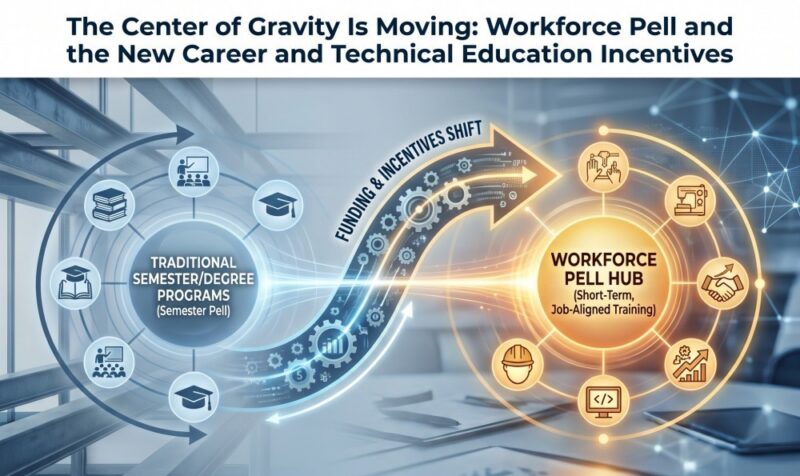
Workforce Pell will officially be framed as a new federal aid option for short-term workforce programs. That is true. But it is not the full story. The deeper story is that Workforce Pell is likely to shift the center of gravity in career and technical education. Workforce Pell and CTE Incentives.
For decades, Pell operated inside a system organized around semesters, degrees, and access. Workforce Pell changes that logic. It directs federal aid toward short-term, job-aligned programs, but it does so through outcomes-based eligibility.
That matters.
Under the proposed federal framework, eligible programs must meet specific thresholds tied to completion, job placement, earnings, and state approval. In other words, this is not just a new funding stream. It is a new incentive structure.
And whenever funding comes with performance conditions, systems begin to reorganize around what can be measured, defended, and sustained.
That is why this is not only a higher education story. It is a CTE story.
The programs most likely to qualify sit right at the intersection of community college CTE, workforce systems, and postsecondary pathways connected to K-12. Health care credentials, IT certifications, logistics training, skilled trades, and industrial maintenance are exactly the kinds of programs that states and institutions will now examine through a new lens:
Can this program produce outcomes strong enough to remain eligible?
That question will shape more than program approval.
It will shape program design.
It will shape employer engagement.
And, it will shape student support structures.
And over time, it may shape which students are most likely to be served.
Where money goes, systems follow
In education, the real center of gravity is whatever a system can reliably fund, count, and justify.
When a funding stream arrives with quality thresholds, institutions do not simply plug it into existing practice. They adapt to it. Institutions build around it. They learn how to protect it.
That is exactly what makes Workforce Pell so important.
Programs will not just need to exist. They will need to prove that students complete them, transition into employment, and generate enough earnings to justify the cost. That pushes institutions toward programs with clearer labor-market value, stronger employer alignment, and more defensible data systems.
It also means documentation becomes strategic, not administrative.
The colleges and providers that succeed in this environment will not just have good programs. They will have programs that can demonstrate performance in ways regulators, states, and the public can recognize.
Quality gates are not neutral
The guardrails in Workforce Pell are understandable. They reflect real concerns about low-value short-term training and the need to protect students and public dollars.
But guardrails also create incentives.
A completion rate does not only reflect teaching quality. It also reflects whether a learner can manage transportation, childcare, work hours, access to technology, exam fees, and life instability long enough to finish.
A placement rate does not only reflect program quality. It also reflects employer demand, hiring behavior, local labor-market conditions, licensing barriers, and whether the credential carries weight.
An earnings threshold may make sense as a quality filter. But it can also favor sectors with higher wage floors while making it harder for some essential but lower-paid entry pathways to qualify.
That is where the real policy tension begins.
The question is not just whether these thresholds improve quality.
The question is how institutions will behave when funding depends on meeting them.
When outcomes drive eligibility, access can become strategic
Once outcomes determine whether a program can access aid, providers will understandably pay close attention to who is likely to complete and who is likely to place.
Sometimes that leads to better advising and better program fit.
Sometimes it leads to quiet forms of risk management.
That may show up in readiness assessments, counseling, screening, accelerated pacing decisions, or support structures that favor students already positioned to succeed quickly.
The learners most vulnerable in that environment are often the very learners the workforce policy asserts that it prioritizes: working adults and parents with childcare responsibilities. constraints, learners who need short-term academic refreshers, people rebuilding stability after justice involvement, and others navigating structural barriers that performance metrics do not fully capture.
This is why the equity question is not secondary.
It is central.
If Workforce Pell expands access only for the easiest-to-serve populations, then the system may produce strong performance numbers while quietly narrowing opportunity.
What smart implementation will require
States and institutions still have real choices here.
If they want Workforce Pell to expand opportunity rather than reward selectivity, three things matter.
First, readiness support must be visible and funded. Bridge programs, basic skill refreshers, digital literacy supports, and pre-apprenticeship experiences may be the difference between formal eligibility and real access.
Second, access patterns should be tracked alongside outcomes. It is not enough to know who completed and who placed. Leaders also need to know who applied, who was advised out, who enrolled, and who did not enroll before the official metrics began.
Third, non-tuition barriers must be treated as part of implementation, not as side issues. If aid covers tuition but not the costs that actually shape completion, institutions may feel pressure to manage performance through enrollment behavior rather than support.
Why states matter most

States will have enormous influence over what Workforce Pell becomes in practice.
They will help define priority sectors.
They will shape approval criteria.
States will influence whether employer engagement is superficial or real.
They will determine whether data capacity, learner support, and access monitoring are built into early implementation or treated as optional extras.
That makes 2026 as much a state governance story as a federal policy story.
Because once early approval patterns are established, they tend to harden into precedent.
The real test
Workforce Pell is not just an expansion of financial aid.
It is a design test for the next phase of CTE and workforce policy.
1)Can the system demand stronger outcomes without quietly reducing access?
2)Can quality and equity be built together?
3)Can states resist the temptation to reward only the easiest wins?
The center of gravity is moving. That part is already built into the policy structure.
The real question is whether leaders will design implementation so that more learners can succeed under the new rules, or whether the system will gradually sort opportunities toward the students and programs that look safest on paper.
If states fail to design for access alongside outcomes, they will not just miss an equity goal.
They will build high-performing systems that leave out the very learners Workforce Pell was supposed to help.
Source: Workforce Pell and CTE Incentives
The Center of Gravity Is Moving: Workforce Pell and the New Career and Technical Education Incentives

STERLING ROBERSON, Retired, Vice President at United Federation Of Teachers
https://independent.academia.edu/RobersonSterling
https://sterlingroberson.substack.com/
https://www.techedmagazine.com/category/resources/funding-grants/
Workforce Pell and CTE Incentives. The center of gravity is moving. It is not enough to know who completed and who placed.