
Risk to Confidence with VR
A few weeks ago was the first time I put on a Virtual Reality (VR) headset. No, it wasn’t in a factory or training room. At an arcade with my kids. It kind of creeped me out as I rode on a virtual rollercoaster, shooting at jellyfish trapped in bubbles in Bikini Bottom. And felt weird and took a bit to get used to being between a digital world and reality, but it showed me how powerful it can be when the two overlap. Risk to Confidence with VR.
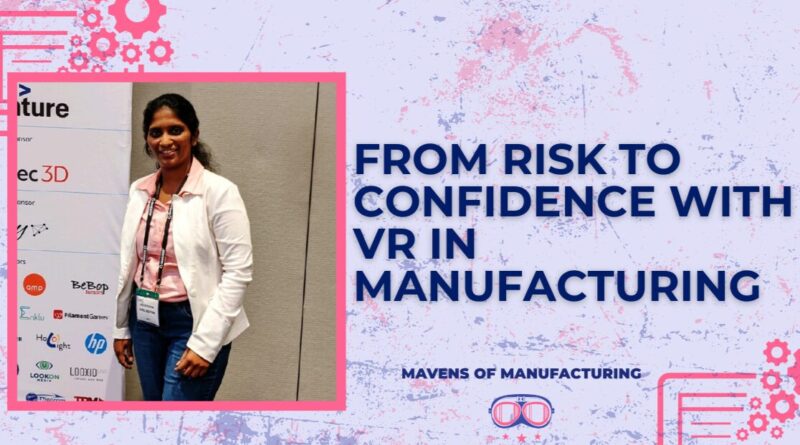
I thought about this experience when I recently interviewed Revathi Pushpam Balachandran on the Mavens of Manufacturingpodcast. She opened my eyes to how VR is transforming safety training in manufacturing. This wasn’t about entertainment anymore. It was about preparing people for dangerous tasks without putting them or expensive equipment at risk.
“Employees can practice in a risk-free environment,” Revathi explained. “They can make mistakes, and they can learn from them, which is not possible in traditional training.”
Revathi’s Journey into Manufacturing
Revathi’s journey into manufacturing didn’t start in a machine shop. She started in IT, building her career in computer science and quality assurance.
For nearly two decades, she worked in software, testing systems and strategies. Her pivot into manufacturing began when her brother, CEO and founder of Aatral, handed her a HoloLens. That single demo changed the course of her career.
“I was fascinated by that experience,” she told me. From that moment on, she began helping him test applications, drawing on her background in QA. She supported events, demos, and eventually started exploring how this technology could fit into workforce development in the United States.
“Seeing the use cases and the impact it was creating in India, I thought it would be a good use case for the U.S. market as well.”
Why Traditional Training Falls Short
I still remember the day I walked into a cutting tools factory for training in the shipping department. They handed me a massive binder filled with pages of text and procedures. I tried to keep up, but the words blurred together. I skimmed, I nodded, and I prayed I would remember something once I was on the floor, but I didn’t until I actually started doing the work.
Revathi echoed this frustration. She listed four major problems with traditional training. “It is less engaging to the employees, the hands-on experience is very minimal, there is no individualized tracking, and there are no real-life simulations,” she said.
That reality leaves new hires unprepared and often embarrassed when they make mistakes in front of seasoned workers.
She stressed that manufacturing needs more than memorization. It needs behavior change, and without immersive tools, that piece goes missing.
What VR Adds to the Training Experience
Virtual reality doesn’t replace classroom instruction; instead, it builds upon it. Workers can begin with a shorter classroom session, then move into a virtual environment where they practice what they learned.
After that, they get hands-on training with real equipment, but by then, the learning curve is shorter and less intimidating.
Revathi broke it down clearly. “This is not a replacement for traditional training. It is an add-on. First, they undergo classroom training, then VR training to practice, and then hands-on. The hands-on period will be much less, and this helps improve productivity.”
She shared results that made me stop and think. One of their customers saw a fifty percent increase in safety adherence after introducing VR training. That meant more workers followed safety requirements and fewer accidents happened. Those kinds of numbers are hard to ignore. Risk to Confidence with VR.
Engaging the Next Generation
Another interesting point brought up during our conversation was how VR connects with Gen Z. This is a generation raised on digital interaction. They swipe, tap, and scroll instinctively. A PowerPoint slideshow doesn’t stand a chance at keeping their attention.
Revathi sees VR as a way to attract younger generations and get them more engaged in engineering and manufacturing.
But this isn’t just for the younger crowd. Aatral has trained more than 30,000 employees across age groups, from boomers to new graduates. With hand-tracking technology, workers don’t need to learn complicated controllers. They simply use natural gestures, like climbing a ladder or grabbing a tool.
“It is easy for anyone to use,” she explained. That ease of use means resistance drops, and even skeptics realize they can adapt quickly.
Barriers to Adoption
Change always comes with challenges, and VR is no exception. Some leaders resist because they prefer the old way of doing things.
Others hesitate because of cost. “Budgets assigned for safety training are very low,” Revathi admitted. Convincing companies to invest in immersive technology requires showing them not only the safety benefits but also the long-term cost savings.
Another obstacle is comparison. Many decision-makers weigh VR against e-learning modules. As Revathi put it, “You can’t compare apples to apples with e-learning and virtual reality training. E-learning is simple to create, but VR involves scanning factories, creating 3D assets, and building interactions.” The depth of effort explains the price difference.
Her team often hosts workshops where workers try the technology themselves. Once leaders see their people fully engaged, feedback shifts, and buy-in is much easier.
Building a Training Experience Like a Story
One detail of the conversation that stuck with me was how Aatral approaches development. Revathi described it like filmmaking. First, her team scans the facility. Then they create a storyboard, almost like a comic strip, showing what the worker will experience step by step. Only after approval do they move into development.
“There should be a story for it,” she explained. “Both sides should agree on the story. Then only will it create the actual impact for the employees.”
This storytelling approach means workers aren’t just completing tasks. They are stepping into a narrative where they are the main character. That level of immersion makes the lessons more memorable and practical once they return to the real world.
Lesson Learned Along the Way
Like any new venture, mistakes shaped Aatral’s path. In the early days, they sometimes invested in building demos before budget conversations were settled.
“When it came to budgets, they would say no, this is not within our budget,” Revathi recalled. Now they set expectations early to avoid wasted effort.
They also learned to rely on detailed storyboards. Early on, clients would approve requirements, but then change their minds after seeing the demo.
However, by presenting the story to clients at the start, those surprises are minimized. It was a painful lesson, but one that improved their process.
Start Small and Scale
Revathi’s simple advice for manufacturers interested in trying immersive tools: “Start small. Don’t think you need to do all the training using VR. That is not feasible,” she said.
Instead, companies should focus on high-risk tasks, like confined space or crane operation, where the payoff is immediate.
I couldn’t agree more. Too often, leaders want all or nothing. But the smartest path is to test a single scenario, measure results, and build from there. That way, companies see clear ROI before making larger commitments.
Beyond Safety
While safety is the starting point, it’s not the end. Aatral is already building VR modules for operational training, assembly processes, plant visualization, and digital twins. They are also creating simulators, like a crane cabin setup that allows workers to practice in a hyper-realistic environment.
The applications go further. “This is not just for manufacturing. It is across any industry, wherever there is a risky situation involved or wherever there is heavy asset equipment,” Revathi explained. From fire evacuation drills in offices to medical simulations, the reach of VR continues to expand.
Looking Toward the Future
When I asked Revathi about the next five to ten years, her answer gave me hope. She believes smart glasses will soon replace bulky headsets, making immersive training even easier to adopt.
She sees shorter training times, faster onboarding, and the preservation of tribal knowledge as older generations retire.
“We build this content with the help of SMEs. Even though the employee has left, the knowledge is retained in digital formats,” she said.
Pair that with AI chatbots integrated into smart glasses, and new hires can troubleshoot problems without flipping through binders or waiting for guidance.
That vision shows a future where knowledge flows freely and workers step into roles with confidence, no matter their background.
My Biggest Takeaway
As I reflected on this conversation, confidence stood out as the real benefit of immersive training. I have been the new worker, nervous about making mistakes.
I have also been the mentor, watching others stumble. VR doesn’t just train skills; it gives people the chance to fail safely, learn quickly, and step into their jobs with assurance.
Revathi summed it up best: “Start small, take a consultative approach, and try use cases that involve heavy equipment or high risk. Then you will realize the benefit.” That advice applies not just to VR, but to how we approach change in general.
Immersive tools are not about replacing people or making training flashy; they are about enhancing the learning experience. They are about protecting workers, preserving knowledge, and giving every employee, no matter their age or background, the confidence to succeed. And in manufacturing, confidence is everything.
Source: Risk to Confidence with VR
Watch Revathi’s full interview here: https://www.youtube.com/live/NjYDK9uP94s?si=KvZHlAP7WdqyOfMN
Subscribe to more inspirational stories here: https://www.youtube.com/@MavensofManufacturing
From Risk to Confidence with VR in Manufacturing

Meaghan Ziemba