
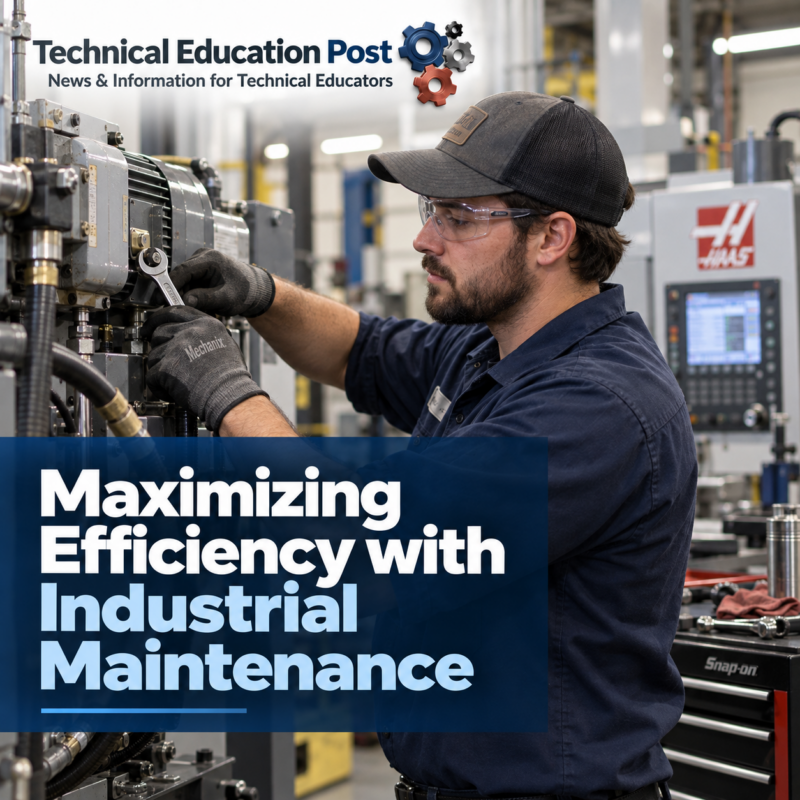
The Pillars of Production: Maximizing Efficiency with Industrial Maintenance
In the dynamic world of manufacturing, where every second of downtime translates to lost output and increased costs, the role of industrial maintenance is paramount. It’s not merely about fixing broken machines; it’s a strategic discipline aimed at ensuring the reliable, safe, and efficient operation of production facilities. For students envisioning a career in the modern industrial landscape, educators seeking to equip them with relevant skills, career changers looking for a stable and impactful profession, and seasoned technicians and manufacturing professionals striving to optimize their operations, understanding and implementing effective industrial maintenance strategies is crucial. This article delves into the core principles, technologies, applications, and career implications of maximizing efficiency through industrial maintenance, providing a comprehensive guide for navigating this vital sector.
In the realm of Industrial Maintenance, understanding the financial support available for workforce development is crucial. A related article that delves into this topic is about the Illinois Department of Commerce and Economic Opportunity’s recent initiative to allocate $16 million in funding aimed at enhancing training programs for skilled trades. This funding is expected to significantly benefit industries reliant on effective maintenance practices. For more information, you can read the article here: Illinois DCEO Funding $16 Million.
Understanding the Foundations: What is Industrial Maintenance?

At its heart, industrial maintenance encompasses all the activities undertaken to keep industrial machinery and equipment in optimal working condition. This includes scheduled inspections, preventative measures, and reactive repairs. The ultimate goal is to minimize unexpected breakdowns, extend the lifespan of assets, ensure worker safety, and maintain consistent production quality and output.
Defining the Scope: Beyond Simple Repairs
It’s essential to differentiate industrial maintenance from basic repair work. While repair is a component, industrial maintenance is a proactive and systematic approach. It involves a deep understanding of the equipment’s operating parameters, failure modes, and the impact of its performance on the entire production chain.
The Evolution of Maintenance: From Reactive to Predictive
Historically, maintenance was largely reactive. Equipment was run until it failed, and then it was repaired. This “run-to-failure” approach, while seemingly cost-effective in the short term, often led to significant production losses, expensive emergency repairs, and potential safety hazards. The evolution has seen a progression through several key stages:
Reactive Maintenance (Breakdown Maintenance)
This is the oldest and least desirable form of maintenance. Actions are only taken when a piece of equipment breaks down. It is characterized by unplanned downtime, emergency part orders, and often higher labor costs due to overtime. While sometimes unavoidable for non-critical components, it’s a strategy to be avoided for essential machinery.
Preventive Maintenance (Time-Based Maintenance)
Preventive maintenance involves performing scheduled maintenance tasks at predetermined intervals, regardless of the equipment’s actual condition. This can include lubrication, cleaning, filter changes, and inspections based on usage hours, calendar time, or production cycles. The aim is to prevent failures before they occur by addressing wear and tear proactively. For instance, changing the oil in a pump every 500 operating hours is a preventive measure.
Predictive Maintenance (Condition-Based Maintenance)
Predictive maintenance takes a more sophisticated approach. It uses monitoring techniques and data analysis to assess the condition of equipment in real-time. By identifying early signs of potential failure, maintenance can be scheduled precisely when needed, optimizing resource allocation and further minimizing downtime. Examples include vibration analysis for rotating machinery, thermal imaging to detect electrical hot spots, and oil analysis to identify wear particles.
Prescriptive Maintenance (Proactive Maintenance)
This is the most advanced form of maintenance, building upon predictive capabilities. Prescriptive maintenance not only predicts when a failure might occur but also recommends specific actions to prevent it, often leveraging artificial intelligence and machine learning. It moves beyond understanding what might happen to understanding why and how to intervene effectively.
The Engine of Operations: How Industrial Maintenance Works

The effectiveness of industrial maintenance hinges on a systematic approach that integrates various strategies and technologies. It’s a continuous cycle of assessment, planning, execution, and analysis.
Implementing Maintenance Strategies: A Multi-faceted Approach
Modern industrial maintenance rarely relies on a single strategy. Instead, a blended approach is most effective, leveraging the strengths of each method.
Industrial maintenance plays a crucial role in ensuring the efficiency and longevity of machinery in various industries. For those interested in pursuing a career in this field, exploring educational opportunities can be beneficial. A related article discusses how Ivy Tech is offering $1,500 scholarships for CNC machinist career training, which can be an excellent stepping stone for individuals looking to enhance their skills in industrial maintenance. You can read more about this initiative in the article found here.
Reliability-Centered Maintenance (RCM)
RCM is a framework that focuses on preserving the function of an asset. It involves analyzing potential failure modes and their consequences to determine the appropriate maintenance tasks needed to prevent those failures, or to mitigate their impact. This is a highly analytical approach that ensures maintenance efforts are focused on the most critical aspects of equipment reliability.
Total Productive Maintenance (TPM)
TPM is a philosophy that aims to improve overall equipment effectiveness through the active involvement of all employees, from senior management to shop floor operators. It emphasizes empowering operators to perform basic maintenance tasks, fostering a culture of ownership and continuous improvement. Key pillars of TPM include autonomous maintenance, planned maintenance, quality maintenance, and early equipment management.
The Role of Technology in Modern Maintenance
The advent of Industry 4.0 has revolutionized industrial maintenance, introducing powerful tools for monitoring, analysis, and prediction.
Sensor Technology and Data Collection
Sensors are the eyes and ears of modern maintenance. They are deployed on machinery to continuously collect data on various parameters such as temperature, vibration, pressure, flow rate, and current. This data forms the foundation for condition-based and predictive maintenance. Examples include:
- Vibration Sensors: Detect anomalies in rotating equipment like motors, pumps, and fans, which can indicate bearing wear, imbalance, or misalignment.
- Thermal Cameras: Identify overheating components in electrical panels, motors, and mechanical systems, signaling potential insulation breakdown or excessive friction.
- Ultrasonic Sensors: Detect leaks in compressed air systems or steam lines, and also monitor the health of bearings.
- Oil Analysis: Analyzes lubricant samples to identify wear metals, contaminants, and changes in oil properties, which can predict component degradation.
Data Analytics and Machine Learning
Raw sensor data, often in vast quantities, is processed and analyzed using sophisticated software. Machine learning algorithms can identify patterns and anomalies that human analysts might miss, enabling more accurate predictions of equipment failure. This allows for the creation of “digital twins” – virtual replicas of physical assets – that can be used for simulation and performance analysis.
Computerized Maintenance Management Systems (CMMS) and Enterprise Asset Management (EAM)
CMMS and EAM software are central to managing maintenance operations. They provide a centralized platform for:
- Work Order Management: Creating, assigning, tracking, and closing maintenance tasks.
- Asset Tracking: Maintaining a comprehensive inventory of all equipment, including its history, specifications, and maintenance records.
- Preventive Maintenance Scheduling: Automating the generation of routine maintenance tasks based on predefined schedules.
- Inventory Management: Tracking spare parts, ensuring availability, and optimizing stock levels.
- Reporting and Analytics: Generating